

Table of Contents
- How to Spot Cheap Clothing Online: Start with Product Photography
- How to Read Clothing Labels Online for Quality Signals
- Signs of Low Quality Clothing: What to Check in Product Descriptions
- How to Spot Fast Fashion vs. Quality When Shopping Online
- Pricing, Return Policies, and Retailer Legitimacy
- Digital Tools and High-Resolution Images: Your Advantage
- Conclusion
- Frequently Asked Questions
Last Updated: September 3, 2026
How to Spot Cheap Clothing Online: Start with Product Photography
The difference between quality clothing and cheap fast fashion often reveals itself in the details you can't see in a thumbnail. When shopping online, your best advantage is access to high-resolution product images that most retailers now provide. Zoom in on fabric texture, seam construction, and overall garment finish. Look for crisp, well-lit photos that show the clothing from multiple angles, including close-ups of seams, hems, and hardware. Retailers confident in their quality typically invest in professional photography that lets you inspect the product thoroughly.
Poor-quality images are themselves a red flag. If a retailer uses blurry photos, limited angles, or heavily filtered pictures that hide the garment's true appearance, that's a signal to move on. Cheap clothing manufacturers often hide construction flaws behind poor photography. Conversely, quality retailers understand that transparent imagery builds trust and reduces returns.
Pay special attention to how fabric drapes in photos. Natural fabrics like cotton, linen, and wool have distinctive drape characteristics that synthetic blends often fail to replicate. Cheap polyester tends to cling awkwardly or look stiff, while quality natural fibers fall smoothly. This visual difference is often apparent even in product photos if you know what to look for.
Pro Tip
Use your browser's zoom function to inspect product photos at 200% magnification. Look for loose threads, uneven stitching, and pilling on fabric surfaces. Retailers selling quality clothing don't mind this level of scrutiny.
How to Read Clothing Labels Online for Quality Signals
The fiber content listed on a garment's care label is your clearest window into quality. A label reading "100% cotton" or "100% linen" signals a commitment to natural fibers, while "65% polyester, 35% cotton" indicates a synthetic blend designed to reduce manufacturing costs. Natural fibers breathe better, age more gracefully, and typically cost more to produce. When you see predominantly synthetic composition, you're usually looking at fast fashion designed for short-term wear.
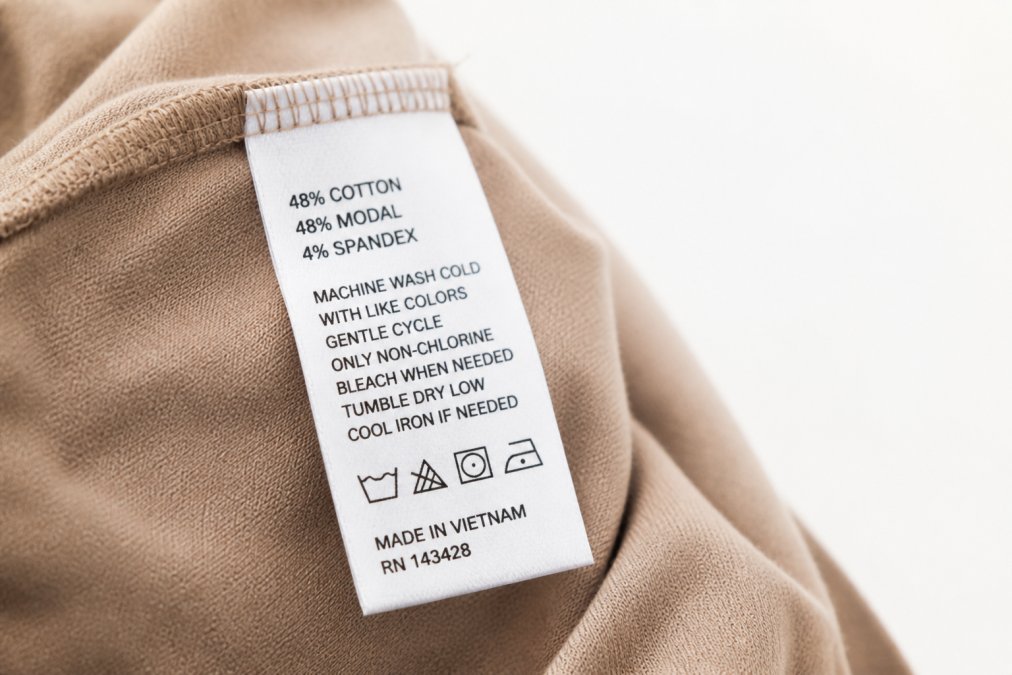
Beyond fiber content, examine the care instructions themselves. Quality garments often come with specific guidance: "Hand wash cold" or "Dry clean only." These instructions suggest delicate construction that requires careful handling. Cheap clothing often says "Machine wash warm, tumble dry," which indicates synthetic materials designed to withstand rough treatment because they're built to last only a few seasons anyway.
The country of origin matters, though not in the way many assume. Garments made in countries with strict labor and environmental standards often cost more but reflect better working conditions. More importantly, look for consistency in manufacturing. A brand that produces all its items in the same facilities tends to maintain quality standards, while a brand jumping between multiple factories may have inconsistent quality control.
Thread count and GSM (grams per square meter) provide technical measures of fabric density. Quality cotton typically measures 200+ GSM, while cheap cotton blends may be 150 GSM or lower (peer-reviewed research). These numbers aren't always listed online, but when they are, higher values indicate denser, more durable fabric. Seam allowance, the amount of fabric between the seam line and the cut edge, should be at least half an inch. Narrow seam allowances tear more easily and indicate cost-cutting measures.
Key Takeaway
Reading labels online requires checking three things: fiber content (prefer natural fibers), care instructions (specific guidance suggests quality), and manufacturing origin (consistency matters more than location).
Signs of Low Quality Clothing: What to Check in Product Descriptions
Fabric Composition and Material Red Flags
Cheap clothing relies on synthetic blends that prioritize cost reduction over performance. When product descriptions emphasize "easy care" or "wrinkle-resistant" without mentioning fiber content, that's typically code for high polyester content. Polyester pills easily, loses shape, and feels plasticky against skin. Quality brands highlight natural fiber percentages because that's their competitive advantage.
Watch for vague descriptions like "fabric blend" without specifying ratios. Legitimate retailers list exact percentages: "60% cotton, 40% polyester." Vague language often masks unfavorable compositions. Similarly, terms like "cotton-feel" or "cotton-like" mean the garment isn't actually cotton, it's a synthetic attempting to mimic cotton's properties.
Colorfastness, how well a garment retains its color through washing, separates quality from cheap clothing. Product descriptions mentioning "colorfast" or "dyed to last" signal attention to this detail. Cheap fast fashion often uses low-quality dyes that fade quickly or bleed onto other garments. If a description warns against washing with other colors or doesn't mention colorfastness at all, assume the dye is unstable.
Natural fibers like wool, silk, and linen command higher prices because they're expensive to source and process. When you see these fibers listed, you're typically looking at a higher-quality garment. Conversely, "microfiber," "polyester," and "nylon" dominate cheap clothing descriptions because these synthetics are inexpensive and easy to manufacture at scale.
Hardware, Seams, and Construction Details
Quality garments describe their hardware, buttons, zippers, snaps, in detail. Look for mentions of "metal buttons," "YKK zippers," or "reinforced snaps." These specific references indicate the manufacturer cares about durability. Cheap clothing uses plastic buttons and low-grade zippers that break after a few uses. Product descriptions rarely mention hardware because it's so obviously cheap.
Examine seam construction in photos and descriptions. Quality garments use finished seams, the raw edges are bound or folded to prevent fraying. French seams, flat-felled seams, and bound seams all indicate quality construction. Cheap clothing uses simple single-stitched seams that fray immediately. Photos showing visible seam construction are a positive sign; descriptions mentioning "reinforced seams" or "double-stitched" signal durability.
Hemlines reveal quality too. A quality hem is even, straight, and uses thread matching the garment color. Cheap clothing often has uneven hems, visible loose threads, or mismatched thread color. In product photos, zoom in on the hem and look for these details. Similarly, buttonholes should be cleanly finished with reinforcing thread. Ragged or poorly finished buttonholes indicate low-quality construction.
Look for mentions of "lining" in product descriptions. Quality dresses, jackets, and structured pieces include lining to improve drape and durability. Cheap garments skip lining to reduce costs. Interfacing, the stabilizing fabric used in collars, cuffs, and waistbands, should be mentioned for structured pieces. Without proper interfacing, these areas lose shape quickly.
Watch Out
Avoid garments described as having "single-stitched seams" or with no mention of seam construction at all. These fall apart quickly. Similarly, plastic zippers and buttons are almost guaranteed to fail within the first season of regular wear.
How to Spot Fast Fashion vs. Quality When Shopping Online
Fast fashion prioritizes volume and speed over longevity. The business model depends on selling as many pieces as possible in the shortest timeframe, which means construction corners are cut everywhere. Quality fashion is designed for multiple seasons of wear, which requires better materials and more careful construction.
Fast fashion retailers release new collections constantly, sometimes weekly. They use trend-driven design and cheap materials to maximize profit margins. Quality retailers release collections seasonally or annually. They invest in timeless design and quality materials that justify higher prices. When you see a retailer with hundreds of new items every week, you're looking at fast fashion designed for disposable wear.
Price alone doesn't determine quality, but it's a useful signal. A $20 dress is almost certainly made from cheap synthetics with poor construction. A $120 dress might be quality, but not always. The key is comparing price to materials and construction. A $60 garment made from 100% linen with reinforced seams represents better value than a $40 polyester blend with single-stitched seams.
Sustainability messaging often masks fast fashion. Terms like "eco-friendly" or "sustainable" sound virtuous, but cheap garments made from recycled synthetics still pill, fade, and fall apart quickly. True sustainability means durability, clothing that lasts years, not seasons. Check whether a retailer discusses garment longevity or only environmental certifications.
The cost-per-wear calculation separates quality from cheap. A $150 dress worn 100 times over five years costs $1.50 per wear (the FTC). A $40 dress worn 10 times before it falls apart costs $4 per wear. Quality clothing typically offers better value despite higher upfront costs. When evaluating price, factor in expected lifespan.
Quality retailers provide detailed size charts and fit information. They understand that proper fit extends garment lifespan and reduces returns. Fast fashion uses inconsistent sizing and minimal guidance because they expect high return rates. If a retailer's size chart is vague or sizing reviews mention inconsistency, that's a red flag.
Pricing, Return Policies, and Retailer Legitimacy
A retailer's return policy reveals confidence in their product quality. Quality retailers typically offer generous return windows because they stand behind their products. Fast fashion retailers often limit returns to 14-30 days and charge restocking fees. Restrictive return policies signal that the retailer expects high dissatisfaction.
Examine shipping and handling policies carefully. Legitimate retailers clearly state shipping costs and timeframes. Hidden fees or vague shipping information is a common tactic of drop-shipping sites that source products from cheap manufacturers. Free shipping offers sound attractive but often hide the cost in inflated product prices. ETHOS CONCEPT offers free shipping on orders over $150, which is a legitimate value signal rather than a gimmick.
Retailer legitimacy matters enormously. Research the company before purchasing. Check whether they have a physical address, working customer service, and consistent online presence. Scam retailers often disappear after collecting payment. Look for customer reviews on independent sites, not just testimonials on the retailer's own website. Consistent positive reviews across multiple platforms signal legitimacy.
Payment security is non-negotiable. Use retailers with secure checkout (look for "https" and a padlock icon). Avoid retailers asking for payment methods like wire transfers or cryptocurrency. Credit card purchases offer buyer protection that other payment methods don't. If a retailer seems evasive about payment options, that's a red flag.
Brand reputation matters for quality. Established retailers invest in maintaining their reputation because repeat customers generate more profit than one-time sales. New retailers or those with few reviews might offer quality, but they carry higher risk. When evaluating unknown retailers, prioritize those with detailed product information and transparent policies.
Best For
Shoppers who want to avoid cheap clothing should prioritize retailers with generous return policies, clear product information, transparent shipping practices, and consistent positive reviews across independent platforms.
Digital Tools and High-Resolution Images: Your Advantage
Online shopping provides tools that in-store shopping doesn't. Use them strategically to assess quality before purchasing. High-resolution product images are your primary tool. Most quality retailers now provide zoomable images showing multiple angles. Use this to inspect seams, fabric texture, hardware, and overall finish. Cheap retailers often use low-resolution photos that hide imperfections.
Video content is increasingly common in online retail. If a product has a video showing the garment being worn and moved, watch it carefully. Video reveals how fabric drapes, how it moves with the body, and whether it maintains its shape. Cheap synthetic fabrics often look stiff or cling awkwardly in video. Quality fabrics with good drape look elegant and move naturally.
Customer photos and reviews provide unfiltered reality. Professional product photos are carefully lit and styled. Customer reviews with photos show how garments look in real life, after purchase, and after washing. Read reviews specifically mentioning durability, fading, shrinkage, and fit consistency. Multiple reviews mentioning the same quality issues indicate a legitimate problem, not a one-off complaint.
Zoom functionality in product photos is essential. Most retailers allow 200-300% magnification. Use this to inspect:
- Seam construction and thread color matching
- Fabric texture and any visible pilling or defects
- Button and zipper quality
- Hem evenness and thread condition
- Lining quality if visible
Product descriptions should include fiber content, care instructions, measurements, and construction details. If any of these are missing, ask the retailer before purchasing. Quality retailers respond promptly to pre-purchase questions. Slow or evasive responses indicate lower customer service standards.
Compare the same style across multiple retailers if available. If one retailer's version costs significantly less, there's usually a reason. Different retailers may source from different manufacturers, resulting in quality variations even for the same brand. Lower price typically reflects lower-quality sourcing.
According to consumer research on online retail quality assessment, shoppers who use available product information and customer reviews make significantly fewer returns due to quality issues. Taking time to thoroughly inspect digital product information pays dividends.
Conclusion
Spotting cheap clothing online requires attention to details that fast fashion retailers hope you'll miss. Examine high-resolution product photos closely, read fiber content and care labels carefully, and assess construction quality through seam details and hardware. Check retailer legitimacy through return policies, customer reviews, and transparent business practices. Quality clothing costs more upfront but delivers better value through durability and timeless design.
At ETHOS CONCEPT, we believe confident women deserve access to quality fashion that makes a statement. Our Atelier Line features carefully constructed pieces using quality materials and thoughtful design, the opposite of disposable fast fashion. When you shop with us, you're investing in pieces that work harder, last longer, and reflect your individuality. Explore our collections and experience the difference that quality craftsmanship makes.
Frequently Asked Questions
Q: What should I look for in online clothing product descriptions to spot cheap clothing?
A: Check for vague descriptions, missing fabric percentages, no mention of lining or interfacing, and absence of garment weight or GSM (grams per square meter). Quality retailers specify fiber content, seam allowance details, and construction methods. If a description lacks specifics about materials and construction, the piece is likely low-quality fast fashion designed for minimal durability.
Q: How can I tell if a garment will shrink or lose shape from online photos and descriptions?
A: Look for the fiber content on the care label in product images. High synthetic blends (polyester, acrylic) resist shrinkage better than 100% natural fibers like cotton or linen, which can shrink 5-10% without proper care. Check for mention of pre-shrunk or preshrunk fabric. Read care instructions carefully; if washing instructions are vague or missing, the retailer may not have tested the garment's durability. Quality brands always specify shrinkage expectations.
Q: What's the difference between fast fashion and quality clothing I can identify online?
A: Fast fashion typically features thin fabrics (under 150 GSM), synthetic-heavy blends, minimal seam allowance visible in photos, and flimsy hardware like cheap zippers or thin buttons. Quality pieces show sturdy thread count, natural fiber percentages, visible reinforced seams, heavy-duty hardware, and detailed care labels. Fast fashion retailers rarely mention garment weight; quality brands do. Check return policies too, fast fashion often has strict no-return policies, while quality retailers offer generous returns because they stand behind durability.
Q: How do I know if a retailer is legitimate and not a drop-shipping site?
A: Legitimate retailers provide detailed product information, clear return policies, verifiable customer reviews on independent platforms, and transparent company information. Check if they offer free or reasonable shipping on orders over a certain amount (not hidden fees). Look for secure checkout (HTTPS), a physical address and customer service phone number, and consistent brand voice across their site. Drop-shipping sites often have vague descriptions, stock photos, and unclear return processes. ETHOS CONCEPT, for example, offers free shipping on orders over $150 and detailed product specifications, signals of a legitimate, quality-focused retailer.
This article was written using GrandRanker