

Table of Contents
- Step 1: Do a Closet Audit Before You Buy Anything
- Step 2: Take Accurate Body Measurements (and Use Them)
- Step 3: Evaluate Fabric Composition and Garment Quality
- Step 4: Tips for Buying Clothes Online Safely, Payment and Cybersecurity
- Step 5: Understand Return Policies, Shipping Costs, and Order Tracking
- Step 6: Navigate Resale and Secondhand Platforms Smartly
- Step 7: Tips for Buying Clothes Online Safely, Sustainable and Ethical Verification
- Common Mistakes to Avoid When Shopping for Clothes Online
Last Updated: July 31, 2026
Online clothing fraud, sizing disasters, and fast-fashion disappointment cost American shoppers significant time and money every year. If you're searching for tips for buying clothes online safely 2026, you're already ahead of most shoppers who click "add to cart" without a second thought. This guide from ETHOS CONCEPT covers every step: from auditing your closet before you spend a dollar, to verifying a retailer's security credentials before entering your card number.
Here's what most guides get wrong: they focus entirely on fit and sizing while ignoring the security and sustainability layers that make online shopping genuinely risky. The tips here address all three dimensions.
Step 1: Do a Closet Audit Before You Buy Anything
Most people skip this step entirely, and it's the reason online shopping carts overflow with pieces that never get worn.
A closet audit is a systematic review of what you already own, identifying gaps and pieces that genuinely serve your style. Spend 30 minutes pulling everything out and categorizing it. You're looking for what's missing and what you keep reaching for, the second category tells you your actual style, not your aspirational one. Online shopping is designed to trigger impulse purchases. Without a clear picture of your wardrobe, you'll keep buying variations of things you already have.
Build a Wish List or Mood Board to Shop Intentionally
Create a wish list or mood board using a notes app, Pinterest board, or notebook before you open a browser. A practical wish list entry looks like this: "Structured blazer, navy or charcoal, size medium, for work and weekend wear." Vague entries like "nice tops" lead to vague purchases that pile up unworn.
Wardrobe project thinking treats your closet as a curated collection rather than a random accumulation. Every new piece should fill a specific gap or replace something worn out. This approach naturally steers you away from fast fashion impulse buys and toward garment quality over volume.
Pro Tip
Before adding anything to a wish list, ask: "Do I already own something that does this job?" This single question eliminates roughly half of most shoppers' impulse purchases.
Step 2: Take Accurate Body Measurements (and Use Them)
Fit accuracy is the single biggest predictor of whether an online clothing purchase succeeds or gets returned. The problem isn't that size charts are useless; it's that most shoppers never take their actual measurements and rely on a size label instead.
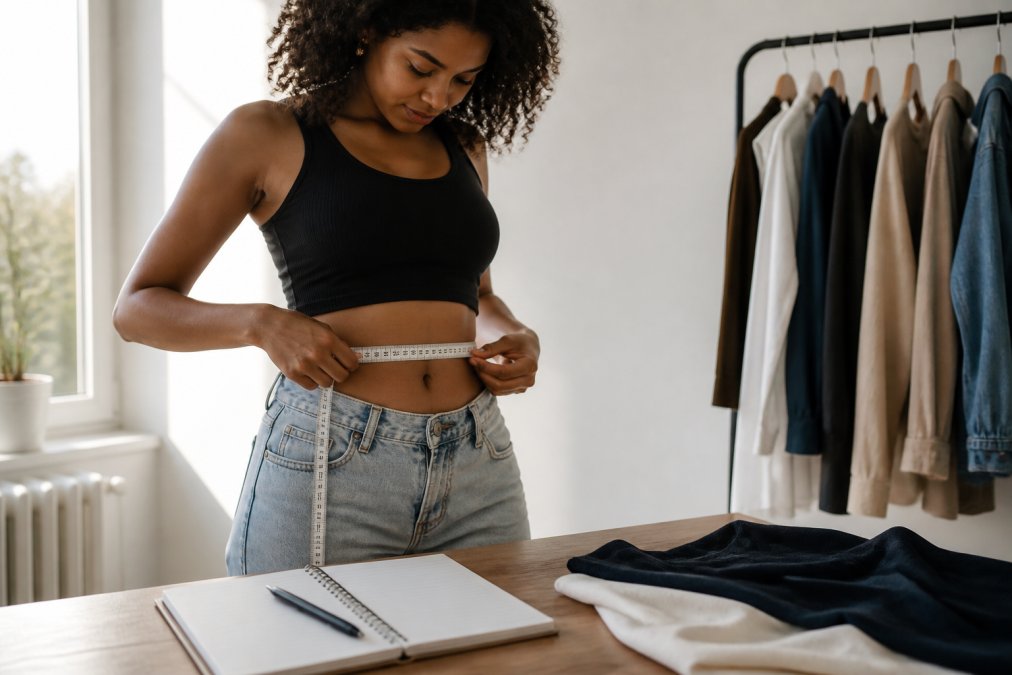
You need four core measurements: bust, waist, hips, and inseam. Use a flexible measurement tape, stand naturally, and measure twice. Write the numbers down. These are the numbers you'll use every time you're buying clothes online.
How to Use Size Charts and AI-Driven Sizing Tools
Every retailer's size chart is different. A size 8 at one brand is a size 10 at another. Always map your measurements to the specific brand's size chart for each order, not your usual size label.
AI-driven sizing tools have become genuinely useful in 2026. Platforms like True Fit and Fit Finder use your measurements, body shape, and past purchase history to recommend specific sizes at specific retailers. Virtual fitting room features let you preview how a garment will drape on a body similar to yours. These tools reduce fit-related returns significantly compared to guessing from a size label alone.
According to FTC guidance on online shopping consumer rights, consumers have specific rights around returns and refunds when products don't match their descriptions.
Comparing Measurements with Garments You Already Own
Instead of trusting a size chart alone, compare the garment's listed measurements directly against a piece you already own and love. Most quality retailers list "garment measurements," not just size recommendations. If a blouse lists a 38-inch bust and your favorite blouse measures 39 inches laid flat, you know exactly what you're getting. Keep a running note of the measurements of your five best-fitting garments.
Step 3: Evaluate Fabric Composition and Garment Quality
Fabric composition is where online shopping gets genuinely tricky, because you can't feel the material before it arrives.
The product description's fabric breakdown is your first filter. Natural fibers like cotton, linen, silk, and wool generally hold their shape and breathe better than synthetics. A 100% polyester blouse priced like a premium piece is almost always a disappointment. Fabric blends can be excellent: a cotton-modal mix is soft and durable, and a wool-nylon blend holds structure better than pure wool.
Textile quality signals to look for in product listings include GSM weight for cotton items, thread count for woven fabrics, specific fiber percentages, country of manufacture, and care instructions that indicate the garment requires attention.
Customer reviews are your best proxy for fabric reality. Search specifically for reviews that mention how the fabric felt after washing. "Pilled after two washes" and "still looks new after a year" tell you more than any product description.
Watch Out
Avoid listings where the fabric composition is vague or missing entirely. A retailer that won't tell you what a garment is made of has something to hide.
Step 4: Tips for Buying Clothes Online Safely, Payment and Cybersecurity
Payment fraud targeting online shoppers is a real and growing threat, and fashion is one of the most targeted retail categories because of high purchase frequency and emotional buying patterns.
How to Verify a Retailer Is Legitimate Before You Check Out
Before entering any payment information, run through this verification checklist:
- Check the URL: The site should use HTTPS (look for the padlock icon).
- Search the domain age: Use a WHOIS lookup tool. Sites created within the last 90 days selling branded fashion are high-risk.
- Look for physical contact information: A legitimate retailer lists a physical address, phone number, and email.
- Read the About page: Generic, AI-generated copy suggests a drop-shipping operation with no accountability.
- Check for real customer reviews off-site: Search "[brand name] reviews" on Google, Trustpilot, the Better Business Bureau, or Reddit.
- Verify social media presence: Active social accounts with real engagement and customer interaction indicate a genuine business.
ETHOS CONCEPT maintains transparent brand information, a clear product origin story through its Viadellerose collection, and verifiable customer touchpoints, exactly the signals a legitimate retailer should provide.
Secure Checkout Practices and Consumer Protection Rights
Use these practices every time you're buying clothes online:
- Pay with a credit card, not a debit card. Credit cards offer stronger fraud protection under the Fair Credit Billing Act.
- Use PayPal, Apple Pay, or Google Pay when available. These services act as intermediaries and never share your full card number with the merchant.
- Avoid saving card details on new sites until you've completed at least one successful transaction and return.
- Enable purchase notifications on your card so you see every transaction in real time.
- Never complete a purchase on public Wi-Fi without a VPN active.
According to Federal Trade Commission consumer protection resources, American consumers have the right to dispute unauthorized charges and receive refunds for items that don't match their descriptions.
Step 5: Understand Return Policies, Shipping Costs, and Order Tracking
Return policies reveal a retailer's actual confidence in their product. A generous, clear return policy signals quality. A buried, restrictive one is a warning.
Before completing any purchase, find the return policy and look for: window length (30 days is standard; under 14 days is restrictive), condition requirements, who pays return shipping, and refund method. Free returns shift risk to the retailer; paid returns shift it to you.
Shipping costs deserve equal attention. Calculate the total landed cost before comparing prices across sites. Order tracking is a basic expectation in 2026. Any retailer that can't provide a tracking number within 48 hours of shipment should be questioned.
| Consideration | Green Flag | Red Flag |
|---|---|---|
| Return window | 30+ days | Under 14 days |
| Return shipping | Free returns | Customer pays |
| Refund type | Original payment method | Store credit only |
| Order tracking | Provided within 48 hours | No tracking offered |
| Shipping costs | Free over a threshold | High flat rate |
| Contact options | Phone, email, chat | Contact form only |
Step 6: Navigate Resale and Secondhand Platforms Smartly
Resale platforms like Poshmark, Depop, ThredUp, and The RealReal are legitimate marketplaces for secondhand fashion where savvy shoppers find quality garments at a fraction of original retail pricing.
The risks differ from traditional retailers. You're often buying from individual sellers, not a brand with standardized quality control. Protect yourself by checking seller ratings and transaction history, requesting additional photos, verifying measurements independently, using platform payment systems only, and understanding authentication for luxury items.
Secondhand shopping aligns with sustainable fashion principles and brings us to the next layer of safe online shopping that most guides ignore entirely.
Step 7: Tips for Buying Clothes Online Safely, Sustainable and Ethical Verification
Sustainable fashion verification is the practice of confirming that a brand's environmental and labor claims are backed by evidence, not marketing copy.
Greenwashing is rampant in online fashion retail, with brands using terms like "eco-friendly" and "conscious collection" without any third-party verification. Unverified supply chains carry real risk: garments produced under exploitative labor conditions have faced regulatory scrutiny and import restrictions in the United States.
How to verify a brand's sustainability claims:
- Look for third-party certifications: GOTS (Global Organic Textile Standard), OEKO-TEX, Fair Trade USA, and B Corp certification are independently verified.
- Check the Good On You app or website: This platform rates fashion brands on environment, labor, and animal welfare using publicly verifiable data.
- Read the supply chain disclosure: Legitimate sustainable brands publish supplier lists or describe their production regions and standards.
- Question vague language: "Made responsibly" and "ethically sourced" without specifics are marketing, not commitments.
According to U.S. Customs and Border Protection guidance on forced labor import restrictions, the Uyghur Forced Labor Prevention Act affects imports of certain textile products, making supply chain transparency a legal issue, not just an ethical one.
Key Takeaway
Sustainable and ethical verification protects you from buying garments that may be subject to import restrictions and ensures your money supports brands that will still be operating next season.
Common Mistakes to Avoid When Shopping for Clothes Online
The biggest mistake isn't buying the wrong size. It's buying without a system.
Shoppers who approach online clothing purchases reactively, responding to sale emails and algorithm recommendations, spend more, return more, and end up with wardrobes full of pieces that don't work together. Use the framework in this guide consistently and the quality of every purchase improves.
Specific mistakes worth naming:
- Buying based on model photos alone. Models are styled, lit, and often wearing clips behind the garment. Always check customer photos in reviews.
- Ignoring fabric composition because the price is right. A cheap price on poor fabric is just a faster path to a garment you won't wear.
- Skipping the size chart because you "know your size." Sizing varies by brand, country of origin, and garment type.
- Treating a final sale as a good deal. Final sale items cannot be returned. Only buy final sale if you've verified measurements, fabric, and seller reputation thoroughly.
- Using a debit card for new retailers. Fraud protection on debit cards is weaker than on credit cards under U.S. consumer protection law.
Managing Shopping App Notifications and Digital Clutter
Shopping apps are engineered to create urgency. Push notifications about "flash sales" and "low stock alerts" are behavioral triggers designed to override deliberate decision-making.
Digital clutter, the accumulation of shopping apps, retailer emails, and promotional notifications, is a genuine obstacle to intentional shopping. Practical steps include unsubscribing from retailer emails for brands you haven't purchased from in 12 months, turning off push notifications for all shopping apps, deleting shopping apps from your phone's home screen, using a separate email address for retail accounts, and scheduling one weekly "shopping window" instead of browsing throughout the day.
As noted in consumer behavior research, notification-driven shopping consistently produces lower satisfaction rates than planned purchases. The inbox and the app store are not neutral environments. Treating them as such is the last piece of buying clothes online safely.
Frequently Asked Questions
How do I know if an online clothing retailer is legitimate before I buy?
Look for a secure checkout URL beginning with 'https,' a clear physical address or contact page, verified customer reviews on third-party platforms, and a transparent return policy. Check that the retailer has active, consistent social media presence and real customer photos. Payment options like PayPal or credit cards offer added consumer protection under the Fair Credit Billing Act, giving you recourse if an order never arrives or is misrepresented.
What is the best way to get accurate body measurements for buying clothes online safely in 2026?
Use a soft fabric measurement tape to measure your bust, waist, hips, and inseam while wearing form-fitting clothing. Record measurements in inches and compare them directly against each retailer's size chart, not generic sizing guides. Many retailers now offer AI-driven virtual fitting room tools that map your measurements to their specific garments. Cross-referencing with a well-fitting garment you already own adds another layer of fit accuracy before you commit.
Are secondhand and resale platforms safe for buying clothes online?
Reputable resale platforms include built-in buyer protections, seller ratings, and dispute resolution processes. Before purchasing, review seller reputation scores, read recent customer reviews, and confirm the platform's return or buyer guarantee policy. Be cautious of transactions pushed off-platform to avoid fees, this removes your consumer protection. Inspect all listed photos carefully and ask sellers for additional images of fabric composition labels or any wear before buying.
How can I avoid impulse buying and stick to a clothing budget when shopping online?
Start with a closet audit to identify genuine gaps in your wardrobe before browsing. Build a wish list of specific pieces and set a firm budget before opening any shopping app. Unsubscribe from promotional emails and turn off push notifications from shopping apps to reduce impulse triggers. A 24-hour waiting rule, adding items to your cart but waiting a day before checking out, is one of the most effective ways to practice intentional shopping and avoid buyer's remorse.
How do I verify that an online clothing brand is genuinely sustainable or ethical?
Look for third-party certifications such as GOTS (Global Organic Textile Standard), Fair Trade USA, or B Corp status, which are independently verified. Read the brand's supply chain transparency page if available. Check whether fabric composition labels disclose material sourcing. Be skeptical of vague terms like 'eco-friendly' without supporting evidence, this is often called greenwashing. Researching a brand's manufacturing country and labor practices through independent directories adds further confidence before you buy.
Shopping for clothes online in 2026 requires more than a good eye for style. It demands measurement accuracy, retailer verification, payment security, and the discipline to shop with intention rather than impulse. ETHOS CONCEPT was built for shoppers who want all of that: a curated selection of bold, high-quality pieces from the exclusive Viadellerose collection, free shipping on orders over $150, and a brand that stands behind every garment. Add to cart with confidence.
This article was written using GrandRanker