

Table of Contents
- How to Identify High Quality Clothing: What to Look For
- Step 1: Examine Signs of High Quality Fabric
- Step 2: How to Check Garment Construction
- Step 3: Evaluate Buttons, Zippers, and Hardware
- Step 4: Assess Garment Fit and Cut
- Step 5: Read Care Labels and Understand Fiber Content
- What Makes a Woman Look Wealthy Through Clothing
- Common Mistakes to Avoid When Assessing Quality
- Frequently Asked Questions
Last Updated: August 31, 2026
How to Identify High Quality Clothing: What to Look For
Knowing how to identify high quality clothing separates savvy shoppers from impulse buyers. The difference between a piece that lasts five years and one that falls apart after a season comes down to small details: how fabric is constructed, where seams are reinforced, and whether hardware will survive repeated wear.
This guide walks you through the specific steps to evaluate clothing like a professional buyer, so you can build a wardrobe of pieces that actually hold up.
Step 1: Examine Signs of High Quality Fabric
The foundation of any quality garment starts with the fabric itself.
Check fiber content and natural fibers
Start by reading the care label's fiber content. Natural fibers like cotton, silk, linen, and wool typically signal higher quality than purely synthetic blends, though not always. Cotton that's tightly woven and densely constructed will outlast loosely woven cotton. Wool resists pilling better than lower-quality synthetics. Linen becomes softer with wear rather than breaking down.
Look for blends that make sense. High-quality blends use synthetic fibers strategically: a small percentage of elastane in denim maintains shape, polyester in a cotton shirt reduces wrinkles while preserving breathability. Cheap blends mix fibers without purpose.
Pro Tip
Check whether the fiber content label lists percentages in descending order. If it does, you're reading accurate information. Quality manufacturers are transparent about composition.
Test fabric weight and density
Run your hand across the fabric and feel its weight. Heavier fabric generally indicates better quality because it requires more fiber to produce. Density matters more than weight alone. Hold the garment up to light and look through it. Dense fabric resists pilling and maintains its shape.
Check the selvedge edge, the finished edge on the side of the fabric roll. Garments cut from selvedge fabric are often higher quality because manufacturers are using premium textile production methods.
Perform the light test for opacity
Hold the garment up to natural light and look through it. Quality fabric maintains opacity even under direct light. Cheap fabric becomes translucent, which means the weave is too loose and won't hold up to washing and wearing.
Step 2: How to Check Garment Construction
Construction quality determines whether a garment will survive its first wash or last for years.
Inspect stitching and seam quality
Turn the garment inside out and examine the stitching closely. Quality stitching is straight, even, and consistent. The thread color matches the fabric. Count the stitches per inch on a seam. Quality garments typically have 12-16 stitches per inch (peer-reviewed research).
Check whether seams are reinforced at stress points. The crotch seam on pants should have a reinforced stitch. Armholes should have double stitching. Necklines should be reinforced where the collar attaches.
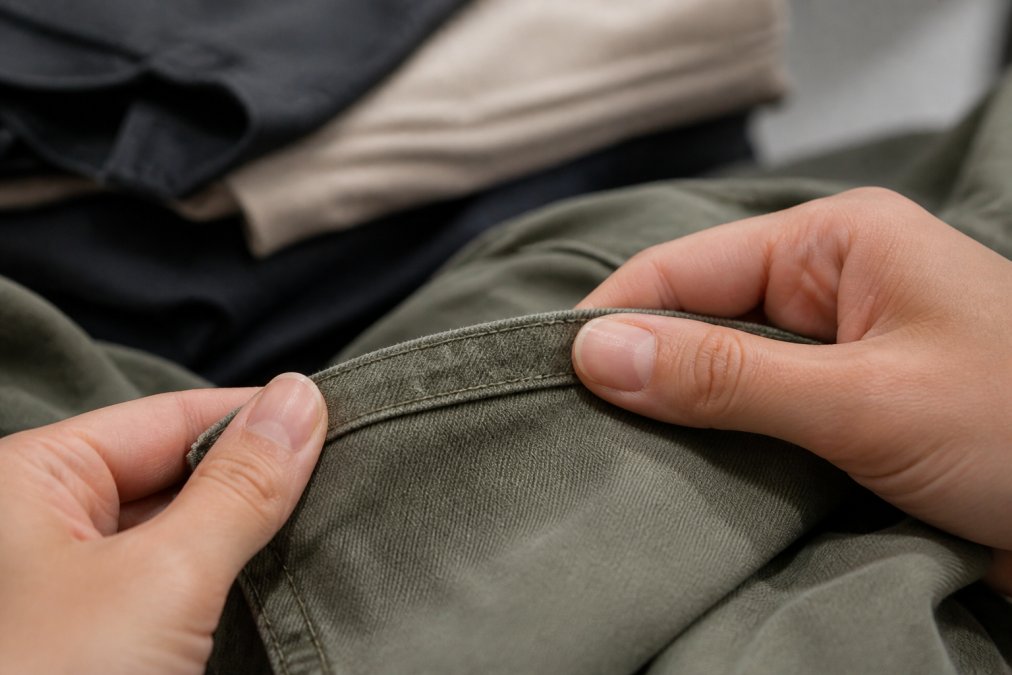
Look for thread tension consistency. If stitching appears puckered or wavy, tension wasn't set correctly during manufacturing.
Look for bound seams and flat-felled construction
High-quality garments use specific seam techniques that reduce fraying and increase durability. Bound seams wrap the raw edge in binding tape to prevent unraveling. Flat-felled seams, common in premium denim and structured shirts, create a seam that's flat on both sides and extremely durable.
Check the inside of seams. If you see raw fabric edges, the garment is lower quality. If seams are finished with binding or a second row of stitching, you're looking at better construction. Examine how the lining is attached if the garment has one. Quality garments have linings sewn securely with interfacing that prevents puckering.
Check pattern matching at seams
For patterned fabrics, quality garments match the pattern at seams. Stripes align at side seams. Plaids match where panels join. This requires careful cutting and skilled sewing, which costs more but signals a manufacturer that cares about details.
Step 3: Evaluate Buttons, Zippers, and Hardware
Hardware is where many garments fail first. Cheap buttons crack, zippers jam, and snaps pop off.
Examine buttons closely. Quality buttons are made from bone, wood, or high-quality plastic that feels substantial. They're sewn on with thread that goes through the button multiple times and is knotted securely underneath. Press the button. It shouldn't move excessively.
Zippers reveal quality immediately. Run the slider up and down smoothly. Quality zippers move without catching or sticking. The slider should feel solid. Check the zipper teeth, they should be evenly spaced and aligned. YKK is considered the gold standard for zippers because they rarely fail (the FTC).
Look at how the zipper is attached. Quality garments have reinforced stitching around the zipper opening. Check snaps and hooks. They should be sewn securely and feel solid when you manipulate them.
Watch Out
Hardware failure is one of the most common reasons garments become unwearable. A button that falls off or a zipper that jams makes the entire piece unusable, even if the fabric and construction are excellent. Always test hardware before purchasing.
Step 4: Assess Garment Fit and Cut
The cut of a garment determines whether it will flatter your body and whether it will hold its shape.
Look at how the garment drapes. Quality pieces are cut to skim the body without clinging. Check the grain line. The grain of the fabric should run straight down the center front and back of the garment. Examine the seam placement. Quality garments have seams positioned where they create clean lines and flattering proportions.
Try the garment on if possible. Quality pieces fit consistently across sizes. Look at how the garment sits on your body. The hem should be even and level. Armholes should sit at your actual armhole. The shoulder seam should sit at your shoulder point.
Step 5: Read Care Labels and Understand Fiber Content
The care label tells you how the manufacturer expects the garment to be maintained. Quality manufacturers provide detailed, accurate care instructions.
Read the fiber content percentage carefully. The percentages should add up to 100%. Look for country of origin. Check whether the label includes washing temperature recommendations. Quality manufacturers provide specific temperatures because they've tested the garment's behavior. Look for shrinkage warnings. Quality manufacturers test for shrinkage and warn you if it's significant.
What Makes a Woman Look Wealthy Through Clothing
Looking wealthy through clothing isn't about designer logos or price tags. It's about understanding what signals quality and investing in pieces that demonstrate you know the difference.
Quality over quantity builds lasting style
A woman who owns ten pieces that fit perfectly, are constructed impeccably, and work together cohesively looks wealthier than someone who owns fifty poorly made pieces. Quality garments have a presence that cheap ones simply don't have. The way they hang, the way they move with your body, and the way they maintain their appearance after repeated wear all signal investment and intentionality.
When everything you wear is well-made, you automatically look more polished. This approach also solves the common problem of having "nothing to wear." When your pieces are quality and work together, you can create multiple outfits from fewer items.

Tailoring and proper fit signal investment
Proper fit is the single most important factor in looking wealthy. A perfectly fitting garment made from average fabric looks better than an expensive garment that doesn't fit well. Quality garments are easier to tailor because they're constructed to accept alterations.
When your clothes fit properly, they automatically look more expensive. The hem sits at the right length. The waist hits at your actual waist. The shoulders align with your shoulders.
Sustainable and ethical manufacturing indicators
How a garment is made matters for both quality and conscience. Garments made in facilities with strong labor standards and environmental practices tend to be better quality because the manufacturer invests in proper processes and skilled workers.
Look for certifications that indicate ethical production. Fair Trade certification, B Corp status, and industry-specific environmental certifications all signal that the manufacturer cares about more than just cutting costs. Research the brand's supply chain transparency. Quality manufacturers are willing to tell you where their garments are made and under what conditions.
Consider the environmental impact of fiber production. Organic cotton requires no synthetic pesticides (usda.gov). Regenerated fibers like Tencel use closed-loop production that recycles water and solvents. Garments made to last longer are inherently more sustainable than garments designed to be disposable.
Key Takeaway
The wealthiest-looking wardrobes aren't built on expensive impulse purchases. They're built on understanding quality, investing in pieces that last, and ensuring everything fits properly. This approach costs less overall because you replace items less frequently and wear everything more often.
Common Mistakes to Avoid When Assessing Quality
Most people make predictable mistakes when evaluating clothing quality.
The first mistake is trusting price as a quality indicator. Expensive garments can be poorly made, and affordable garments can be well-constructed. Evaluate the garment itself, not the price tag.
The second mistake is ignoring the care label. A beautiful piece that requires dry cleaning every time you wear it becomes impractical for most people.
The third mistake is not trying garments on. Fit is too personal to assess without wearing the piece. The fourth mistake is confusing trend with quality. Ask yourself whether you'll wear the piece in two years, not just this season.
The fifth mistake is buying based on brand reputation alone. Evaluate each garment individually. The sixth mistake is not checking for visible defects before purchasing. Loose threads, stains, and misaligned seams should all be red flags.
The seventh mistake is underestimating the importance of seam finishing. Unfinished seams will fray and fall apart. The eighth mistake is not considering longevity when comparing prices. Calculate cost per wear, not just upfront price.
Learning to identify high quality clothing transforms how you shop and builds a wardrobe you actually love wearing. When you understand the details that matter, fiber content, construction techniques, hardware quality, and proper fit, you can spot quality quickly and confidently.
At ETHOS CONCEPT, we apply these same standards to every piece in our collection. Our Atelier Line features limited-edition pieces constructed with the attention to detail that creates garments worth keeping for years. By understanding what you're looking for, you can identify pieces that deliver real value and build a wardrobe that reflects your investment in quality and style.
Frequently Asked Questions
Q: What are the signs of high-quality fabric I should look for?
A: High-quality fabric feels substantial and has appropriate weight for its type. Look for natural fibers like cotton, wool, linen, or silk, or quality synthetic blends. Check the fiber content on the label, higher percentages of natural materials typically indicate better quality. Use the light test: hold the fabric to light and look for opacity; transparent or thin fabric suggests lower quality. Quality fabric resists pilling and maintains its shape after washing.
Q: How do I check if garment construction is solid?
A: Inspect seams closely for tight, even stitching with appropriate stitch density. Look for bound seams or flat-felled seams, which are more durable than simple stitches. Check that patterns match at seams and that raw edges are finished, not left exposed. Examine buttonholes for reinforcement and ensure all fasteners are secure. High-quality garments have interfacing in structural areas like collars and cuffs to maintain their shape through wear and washing.
Q: Does a higher price tag always mean better quality clothing?
A: Not necessarily. Price reflects brand reputation, marketing, and sometimes exclusivity rather than quality alone. Affordable brands can produce well-constructed garments, while luxury labels sometimes rely on branding over durability. Compare construction details, fabric quality, and longevity across price points. Focus on the specific garment's craftsmanship rather than the brand name. Look for value: a moderately priced piece with excellent stitching and natural fiber content often outperforms an expensive item with poor construction.
Q: What makes a woman look wealthy through her clothing choices?
A: Quality over quantity creates a wealthy appearance. Well-fitted, durable pieces in neutral or sophisticated colors signal investment in your wardrobe. Proper tailoring, whether built-in or custom, shows attention to detail. Sustainable and ethically made garments often display superior craftsmanship. Choosing timeless styles over fast-fashion trends suggests confidence and refinement. Maintenance matters too: garments without pilling, loose threads, or fading look expensive. Strategic pieces from quality brands mixed with carefully selected affordable items create an elevated aesthetic.
This article was written using GrandRanker