

Table of Contents
- Why Fast Fashion Clothes Fall Apart: The Root Causes
- Understanding Fast Fashion Materials and Their Limitations
- The Technical Breakdown: Seam Construction and Garment Longevity
- Environmental Impact of Fast Fashion and Textile Waste
- How to Identify Good Quality Clothing and Avoid Poor Construction
- Extending Clothing Lifespan: Cost-Per-Wear and DIY Maintenance
- Consumer Behavior and Overconsumption: Breaking the Fast Fashion Cycle
- Building a Sustainable Wardrobe That Actually Lasts
Why Fast Fashion Clothes Fall Apart: Quality Breakdown
Last Updated: July 29, 2026
Understanding why fast fashion clothes fall apart requires examining the economics, manufacturing shortcuts, and material choices that define the industry. At ETHOS CONCEPT, we recognize that quality construction and durability matter when building a wardrobe that lasts. The average fast fashion garment is worn only seven to ten times before being discarded, not by accident, but by deliberate design.
Why Fast Fashion Clothes Fall Apart: The Root Causes
Fast fashion retailers don't lack the ability to make durable clothing. They choose not to because durability conflicts with their business model. They profit by selling volume at razor-thin margins, so every cent saved on production directly impacts the bottom line. If a shirt lasted five years, customers would buy fewer shirts. But if it falls apart after a season, they return for replacements. This isn't a bug, it's a feature.
Key Takeaway
Fast fashion's profitability depends on short garment lifespans. Durability is treated as a cost to minimize, not a feature to maximize.
Speed Over Quality: Manufacturing Shortcuts
When a retailer needs to produce 50,000 units in six weeks, quality control becomes secondary. One common shortcut uses weaker thread than the fabric itself, when a seam fails, the thread breaks first. Factories also reduce stitches per inch (SPI). A quality garment has 20 SPI; fast fashion pieces often have 10-12 SPI. Fewer stitches mean faster production but proportionally weaker seams prone to separation. Quality garments reinforce stress points like armholes and crotches; fast fashion skips these reinforcements. Many manufacturers also skip pre-shrinking, so garments shrink unpredictably after the first wash, warping shape and straining seams.
Understanding Fast Fashion Materials and Their Limitations
Material selection reveals the disconnect between cost and durability. Quality clothing uses high-grade natural fibers like Pima cotton, linen, or wool. Fast fashion uses low-grade synthetics and blends designed for cheapness, not longevity.
Low-Grade vs. High-Grade Cotton: A Material Science Comparison
Cotton grade matters enormously. High-grade cotton (Pima or Egyptian) has longer fibers that create stronger yarn and resist pilling. Fast fashion typically uses low-grade cotton or cotton-polyester blends. Low-grade cotton has shorter fibers that don't interlock effectively, creating weaker yarn prone to pilling, a visible sign of fiber degradation that accelerates with each wash.
High-grade cotton costs roughly 30-40% more per pound than low-grade cotton. For retailers operating on 5-10% margins, this difference is substantial enough to change sourcing decisions. Cotton-polyester blends shrink unevenly. Cotton and polyester have different shrinkage rates, creating stress on seams and distorting the garment's shape after just a few washes.
Watch Out
Low-grade cotton blends shrink unpredictably and create uneven stress on seams. After 3-5 washes, the garment's shape may be permanently distorted.
Synthetic Fibers and Microplastics: Hidden Durability Issues
Polyester dominates fast fashion for cost reasons, but these advantages come with durability tradeoffs. Every wash releases tiny plastic fibers into the water system, indicating the garment itself is breaking down. Over time, this shedding weakens the fabric until it becomes brittle and prone to tearing. Low-quality polyester is especially problematic because the fibers are thinner and less durable than high-quality polyester. These garments pill more easily, fade faster, and lose shape quickly.
The Technical Breakdown: Seam Construction and Garment Longevity
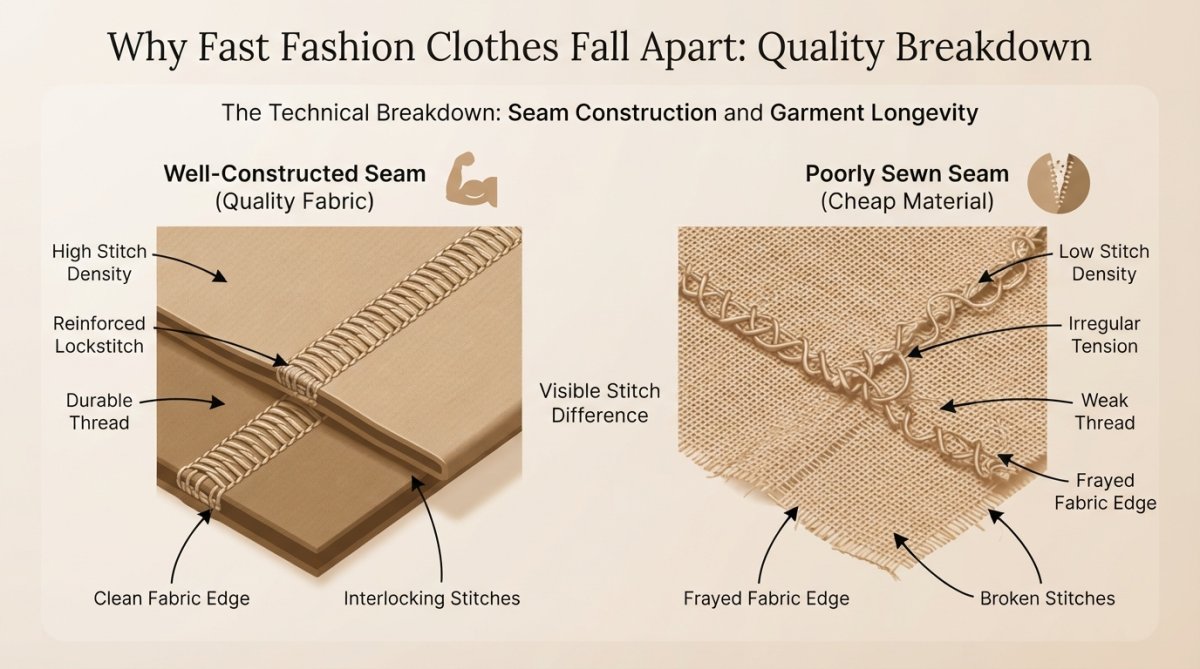
If materials are the foundation of durability, seam construction is the architecture. A garment is only as durable as its weakest seam.
How Seam Strength Determines Garment Lifespan
Seam strength depends on three factors: stitches per inch, thread quality, and reinforcement at stress points. Quality garments use 16-20 SPI with high-strength thread and reinforcement at critical areas. Fast fashion uses 8-12 SPI with weak thread and minimal reinforcement.
A quality seam withstands hundreds of wash cycles and years of wear. A fast fashion seam often fails within 20-30 washes through gradual separation. Low SPI means each stitch bears more load; the thread stretches, the connection weakens, and the seam opens. Quality garments reinforce armholes, crotches, and side seams with extra stitching or additional seam layers. Some fast fashion manufacturers use single-needle stitching instead of double-needle. Single-needle seams are faster but significantly weaker and prone to unraveling if the thread breaks.
Pro Tip
Check seam construction before buying: Look at stitching under the armhole or at the crotch seam. Tight, dense stitching (16+ per inch) indicates quality. Loose, sparse stitching (8-12 per inch) indicates durability problems.
Pilling, Shrinkage, and Fabric Deterioration
Pilling occurs when loose fibers tangle into small balls. This happens faster in low-quality materials. Low-grade cotton and cheap synthetics pill after a few wears; high-quality fabrics may not pill noticeably for years. Once pilling starts, it accelerates, each pill pulls more fibers loose, creating a cascade of deterioration.
Most fast fashion garments aren't pre-shrunk, so they shrink during the first wash. A 5-10% shrinkage makes garments unwearable. Beyond size change, shrinkage creates stress on seams. Blended fabrics shrink unevenly. Cotton shrinks more than polyester; in a 50/50 blend, cotton wants to shrink while polyester resists, creating internal stress that manifests as distortion and seam separation.
Environmental Impact of Fast Fashion and Textile Waste
The durability problem creates an environmental crisis. When garments fall apart after months, they end up in landfills. The United States generates millions of tons of textile waste annually, predominantly from discarded fast fashion pieces.
From Closet to Landfill: The Lifecycle of a Fast Fashion Garment
A typical fast fashion garment is produced in 4-6 weeks using low-quality materials and rushed manufacturing, transported thousands of miles, worn 7-10 times, then discarded. In landfills, synthetic fibers like polyester take 200+ years to decompose. Textile production requires massive amounts of water, roughly 2,700 liters to produce a single cotton shirt. If worn only 7 times before discard, the water cost per wear is staggering.
Buying durable garments worn for years dramatically reduces environmental impact. A garment worn 200 times instead of 7 reduces per-wear environmental cost by 96%. According to EPA textile waste statistics, Americans discard roughly 11 million tons of textile waste annually, with the vast majority ending up in landfills.
How to Identify Good Quality Clothing and Avoid Poor Construction
Quality indicators are visible and learnable. You don't need expertise to spot the difference between garments designed to last and those designed to fail.
Seven Signs of Quality Construction You Can Check Before Buying
1. Seam Density and Thread Quality Hold the garment to light and examine seams. Quality seams have tight, dense stitching with no gaps, 16+ stitches per inch. The thread should be smooth and consistent. Fast fashion seams look sparse and uneven with visible gaps.
2. Fabric Weight and Hand Feel Quality fabrics have substantial weight and pleasant tactile feel. High-grade cotton feels soft and substantial; low-grade cotton feels thin and papery.
3. Reinforced Stress Points Examine armholes, crotches, and side seams. Quality garments have visible reinforcement, extra stitching or additional seam layers at critical points. Fast fashion has no reinforcement.
4. Finished Edges and Hems Look inside the garment. Quality construction has finished edges; hems are sewn neatly with no loose threads. Seams are finished to prevent unraveling.
5. Fabric Grain and Pattern Alignment If the garment has a pattern or stripe, check alignment at seams. Misaligned patterns indicate rushed manufacturing and correlate with poor seam construction.
6. Button and Hardware Quality Examine buttons, zippers, and snaps. Quality garments use substantial buttons sewn with thread that won't break easily. Zippers should move smoothly.
7. Fiber Content and Blend Ratios Read the label carefully. Pure natural fibers (100% cotton, 100% wool) are generally more durable than blends. If blended, check the ratio, 80/20 cotton/polyester is better than 50/50.
Reading Labels: What Fiber Content and Care Instructions Really Mean
Fiber content percentages tell you what the garment is made from. Care instructions reveal something about expected durability. If a garment requires hand washing in cold water, the fabric is delicate. A garment that can be machine washed and dried is more durable. Look for "pre-shrunk" on the label, indicating the fabric was treated to prevent shrinkage. Also look for "colorfast," meaning the dye won't bleed or fade easily.
Extending Clothing Lifespan: Cost-Per-Wear and DIY Maintenance
Understanding why fast fashion clothes fall apart is useful, but the practical question is how to build a wardrobe that lasts.
Calculate Your Cost-Per-Wear to Justify Quality Investment
Cost-per-wear changes how you think about clothing purchases. Instead of looking at the price tag, divide the garment's price by the number of times you'll wear it:
Cost-Per-Wear = Purchase Price ÷ Number of Wears
A $20 fast fashion shirt worn 7 times costs $2.86 per wear. An $80 quality shirt worn 200 times costs $0.40 per wear. A $150 quality pair of jeans worn 500 times costs $0.30 per wear. Quality garments are actually cheaper than fast fashion. Yes, they cost more upfront, but because they last longer, the per-wear cost is dramatically lower.
Key Takeaway
A $100 garment worn 200 times costs $0.50 per wear. A $30 garment worn 15 times costs $2 per wear. Quality garments are cheaper in the long run.
Repairability and DIY Maintenance: Extending Garment Life
Quality garments are worth repairing; fast fashion pieces usually aren't. Basic repairs are simple and save money: sew seams closed immediately, sew buttons back on promptly, patch or darn small holes, and use a fabric shaver to remove pills. Wash in cold water, use gentle detergent, and avoid the dryer. Heat damages fibers and accelerates deterioration. Air drying is gentler and extends garment life.
Consumer Behavior and Overconsumption: Breaking the Fast Fashion Cycle
Understanding why fast fashion clothes fall apart is only half the solution. The other half is understanding why people buy fast fashion and how to break that cycle.
The 'Fast Food' Analogy: Why We Buy More When Quality Drops
Fast fashion works like fast food, cheap, convenient, and immediately satisfying. The low price makes you buy more. A $15 shirt is cheap enough to buy multiple without considering durability. But if you buy 10 cheap shirts that fall apart, you've spent $150 on shirts lasting months. If you buy 2 quality shirts lasting years, you've spent the same amount on far more durable pieces. Fast fashion marketing reinforces this pattern by releasing new collections constantly, creating the sense that existing wardrobes are outdated. Breaking this cycle requires recognizing long-term cost. When you calculate cost-per-wear, cheap fast fashion suddenly looks expensive.
Building a Sustainable Wardrobe That Actually Lasts
Creating a wardrobe that lasts requires intentional choices at every stage. ETHOS CONCEPT's approach to fashion demonstrates that durability and style don't have to be mutually exclusive.
Start with quality basics. Quality jeans, white t-shirts, neutral sweaters, and simple blazers are the foundation of any functional wardrobe. These pieces should be high quality because they're worn frequently. Next, add pieces reflecting your personal style. Be intentional: will you wear this 50+ times? If not, buy lower-quality or secondhand. Finally, commit to maintenance. Wash in cold water, air dry when possible, and repair small issues immediately.
The shift from fast fashion to a sustainable wardrobe is ultimately a mindset shift. View clothing as an investment, not disposable. Buy quality over quantity. Build a cohesive wardrobe of pieces you genuinely love. According to Ellen MacArthur Foundation textile waste research, extending a garment's active life by nine months reduces its environmental impact by 20-30%.
Fast fashion clothes are designed to fail. Understanding why, from planned obsolescence to manufacturing shortcuts to low-quality materials, helps you make different choices. Quality garments cost more upfront but are cheaper per wear and better for the environment. By choosing durable pieces, calculating cost-per-wear, and committing to maintenance, you can build a wardrobe that lasts. ETHOS CONCEPT's commitment to high-quality, affordable fashion demonstrates that you don't have to choose between style and durability.
Frequently Asked Questions
What materials are fast fashion clothes made of, and why do they deteriorate so quickly?
Fast fashion typically uses low-grade synthetic fibers like polyester blends and low-quality cotton to minimize costs. These materials lack the fiber integrity of premium fabrics, synthetic fibers shed microplastics during washing, while cheap cotton has shorter fibers that break down faster. The combination of inferior raw materials and aggressive manufacturing shortcuts means these garments lose shape, pill, and tear within a few washes, compared to quality pieces that maintain durability for years.
How does extending clothing lifespan compare to buying new fast fashion items?
Extending clothing lifespan through proper care and repairs is far more cost-effective. Using the cost-per-wear calculation, a $30 fast fashion item worn 5 times costs $6 per wear, while a $80 quality piece worn 100 times costs only $0.80 per wear. By washing garments in cold water, air-drying, and making simple repairs like restitching seams, you can double or triple a garment's life, saving money while reducing textile waste sent to landfills.
Why do seams fall apart so easily on cheap clothing?
Fast fashion manufacturers use manufacturing shortcuts to cut costs: they reduce stitch density (fewer stitches per inch), use low-quality thread, and rush production. Quality seams have 12-16 stitches per inch with reinforced stress points; fast fashion often has 6-8 stitches per inch. This weak seam construction is one of the primary reasons garments tear at stress points like underarms and crotches within weeks of wear, making the entire garment unwearable despite the fabric itself being intact.
What's the environmental impact of fast fashion's poor quality and short lifespan?
When garments fall apart quickly due to poor quality, they end up in landfills far sooner than durable alternatives, contributing significantly to textile waste and pollution. The lifecycle of a fast fashion garment is short: manufactured quickly using water-intensive processes, worn briefly, then discarded. This cycle drives overconsumption and creates massive textile pollution. Additionally, synthetic fibers shed microplastics during every wash, contaminating water resources. A single quality garment worn for years has a fraction of the environmental impact of buying multiple cheap replacements.
This article was written using GrandRanker