

Table of Contents
- How to Spot High Quality Clothing Online: Start With Product Photography and Descriptions
- Signs of Good Quality Fabric: Natural Fibers vs. Synthetic Materials
- How to Check Clothing Quality Before Buying Online: Examine Seams, Stitching, and Construction
- Best Fabrics for Durability and Wardrobe Longevity
- Identifying Well-Made Clothes: Brand Transparency and Ethical Manufacturing
- Common Mistakes to Avoid When Shopping for Quality Clothing Online
- Your Checklist: How to Spot High Quality Clothing Every Time You Shop
- Conclusion
Last Updated: July 28, 2026
How to Spot High Quality Clothing Online: Start With Product Photography and Descriptions
Learning how to spot high quality clothing online begins with what you can see before you even add anything to your cart. At ETHOS CONCEPT, we've analyzed thousands of product listings to understand what separates investment pieces from disposable fashion. High-quality brands invest in photography that shows fabric texture, construction details, and realistic drape through multiple angles, zoom capabilities, and lifestyle shots.
What to Look for in Product Photos
The quality of product photography signals confidence in the product. Retailers selling well-made clothing show close-ups of seams, fabric weave, and hardware photographed on models in natural lighting. You should be able to zoom in and see individual stitches, fabric texture, and how the material catches light.
Pay attention to consistency across photos. If one image shows the garment looking crisp while another reveals wrinkles or loose threads, that's a red flag. Look for lifestyle photography showing how the garment drapes on a real body. High-quality fabrics hold their form without clinging awkwardly, while fast fashion often photographs in ways that hide poor drape.
Reading Beyond Marketing Copy
Product descriptions reveal how much the brand understands their own product. Specific descriptions include fiber percentages, fabric weight measured in GSM (grams per square meter), country of manufacture, and detailed care instructions. According to research from the Sustainable Apparel Coalition's standards for transparency, brands that provide detailed fabric composition demonstrate higher quality standards.
Read what the brand doesn't say as much as what they do. If a product description avoids mentioning fiber content, cheap synthetic blends are likely being hidden under vague "premium fabric" language. Legitimate brands lead with specifics: "100% Italian linen" or "80% wool, 20% silk blend from certified sustainable sources."
Signs of Good Quality Fabric: Natural Fibers vs. Synthetic Materials
Quality clothing typically starts with superior fiber choices. Natural fibers like wool, linen, silk, and cotton generally age better and develop character over time, but high-quality synthetic materials can outperform poor-quality natural fibers in durability and maintenance. The real indicator of quality is whether the fiber was selected intentionally for the garment's purpose.
Understanding Fabric Weight and GSM
Fabric weight measured in GSM (grams per square meter) is one of the most reliable indicators of quality you can find online. Lightweight fabrics under 150 GSM tend to feel thin and transparent. Mid-weight fabrics between 150-250 GSM provide substance without bulk. Heavy fabrics above 250 GSM feel substantial and durable. A quality t-shirt typically weighs 150-200 GSM, while cheaper t-shirts often measure 100-130 GSM and feel papery after a few washes.
Different garment types require different weights. A summer linen shirt might be 120 GSM and still be quality, while a winter sweater should be 300+ GSM. The key is whether the weight matches the garment's intended use. The Textile Exchange standards for fabric quality establish that fabric weight consistency indicates better manufacturing control.
Identifying Pilling and Durability Risks
Pilling, those small balls of fiber that form on fabric surfaces, reveals lower quality fibers and looser weave structures. Product photos should show smooth fabric surfaces. High-quality fabrics resist pilling because the fibers are stronger and more densely woven.
Look for product reviews that mention pilling as a problem. If multiple customers report pilling after a few washes, the fabric composition is likely low-grade. Conversely, reviews mentioning garments holding up well after a year of regular wear indicate durable construction.
Pro Tip
Check the product photos for close-ups of the fabric surface. If you can see the weave structure clearly and it appears tight and consistent, that's a positive sign. Loose, visible weaves indicate lower-quality fabric that will likely pill and deteriorate faster.
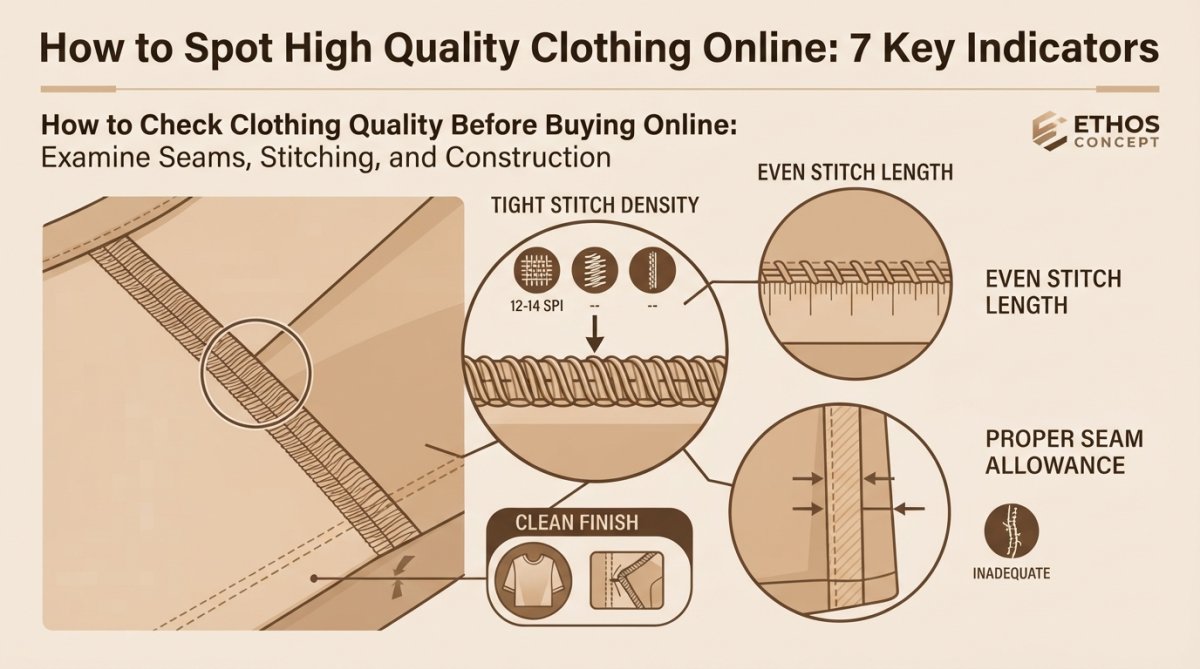
How to Check Clothing Quality Before Buying Online: Examine Seams, Stitching, and Construction
You can't feel fabric through a screen, but you can analyze construction details that reveal how carefully a garment was made. Seams, stitching, and hardware are where corners get cut in fast fashion, making them your best quality indicators when shopping online.
Stitch Density and Seam Allowance Signals
Stitch density, the number of stitches per inch, directly correlates with durability. High-quality garments typically have 12-16 stitches per inch on visible seams. Budget clothing often has 8-10 stitches per inch, meaning seams fail faster under stress. When you zoom in on product photos, tight, evenly-spaced stitching indicates quality manufacturing.
Seam allowance, the fabric between the actual seam and the edge of the garment, should be substantial, typically 0.75-1 inch. This allows for alterations and prevents seams from unraveling. Look for reinforced seams at stress points like armholes and crotch seams. Quality brands double-stitch these areas or use box stitching patterns that distribute stress across multiple stitch lines.
Hardware Quality: YKK Zippers, Buttons, and Reinforcement
The hardware on a garment, zippers, buttons, snaps, and rivets, reveals manufacturing standards immediately. YKK zippers are the industry standard for quality and typically outlast the garment itself. Cheap zippers stick, separate, and fail within months.
Quality garments use buttons made from natural materials like bone or horn, or high-quality resin. In product photos, examine button attachment points; quality construction shows buttons securely sewn with multiple thread passes creating an X or asterisk pattern underneath.
Look for fabric reinforcement patches behind buttons on heavy coats or structured garments. Quality brands reinforce zipper attachments with additional stitching or fabric strips that prevent zippers from pulling away from the garment.
Best Fabrics for Durability and Wardrobe Longevity
Certain fabrics consistently deliver better durability and longer wardrobe life.
Weave Quality and Tensile Strength
Weave structure determines how fabric behaves over time. Tight weaves resist pilling and maintain shape better than loose weaves. A tight twill weave, common in quality trousers and jackets, creates fabric with excellent tensile strength. When you read fabric descriptions, look for mentions of weave type: twill, oxford, sateen, or herringbone indicate intentional construction choices.
Jersey knit fabrics should have tight, even loops. Loose jersey knits develop holes and lose their shape quickly. Linen represents one of the most durable natural fibers available and actually improves with age. The difference comes down to how the linen was processed and how tightly it was woven.
Shrinkage and Care Label Clues
Care labels reveal how a garment was treated during manufacturing. Quality garments are pre-shrunk to minimize shrinkage after purchase. When a care label says "pre-shrunk" or "sanforized," that indicates the manufacturer controlled shrinkage during production. Garments without pre-shrinkage treatment may shrink 5-10% in the first wash.
Look for fabric content percentages on care labels in product photos. A garment listed as "65% polyester, 35% cotton" tells you exactly what you're buying. Vague descriptions like "poly blend" hide the actual composition.
Key Takeaway
The care label is a quality document. Detailed, specific instructions indicate a manufacturer who understands their materials and expects the garment to last long enough to require proper maintenance.
Identifying Well-Made Clothes: Brand Transparency and Ethical Manufacturing
How a brand communicates about their manufacturing process reveals quality standards. Transparent brands invest in supply chain visibility because they're proud of their practices.
Return Policy as a Quality Signal
A brand's return policy directly reflects their confidence in quality. Brands selling high-quality clothing typically offer generous return windows, 30, 60, or even 90 days, because they know customers will keep the items. Fast fashion brands often limit returns to 14 days, knowing garments will deteriorate quickly.
Free returns indicate quality confidence. When a brand covers return shipping, they're betting on customer satisfaction. Check the return policy before purchasing. A 60-day return window with free returns gives you time to wash and wear the garment before deciding to keep it.
Evaluating Brand Reputation and Customer Reviews
Real customer reviews reveal durability patterns that marketing can't hide. Look for reviews mentioning how long customers have owned the garment. Someone saying "I've worn this weekly for two years" tells you far more than generic praise.
Negative reviews revealing specific problems indicate quality issues. Check whether the brand responds to negative reviews. Quality-conscious brands engage with customer concerns; brands that ignore feedback are hiding quality issues.
Common Mistakes to Avoid When Shopping for Quality Clothing Online
Several predictable errors undermine careful shoppers' ability to spot quality.
Fast Fashion vs. Quality: Price Doesn't Always Indicate Value
The assumption that higher price equals better quality leads many shoppers astray. Some expensive brands use celebrity endorsement rather than superior materials. Price becomes meaningful only when compared to specific quality indicators. A $40 shirt made from 100% organic cotton with 14 stitches per inch and YKK zippers represents better value than a $60 shirt made from thin polyester with loose stitching.
Quality brands design for longevity, which means higher upfront cost but better cost-per-wear over time. A $120 sweater worn 100 times costs $1.20 per wear. A $30 sweater worn 20 times costs $1.50 per wear.
Digital-Specific Pitfalls: Lighting, Angles, and Styling Tricks
Product photography uses lighting and angles that can deceive. Harsh backlighting hides fabric flaws. Soft, diffused lighting reveals true fabric quality. Angles matter enormously; shooting from below makes garments appear fuller than wearing them will be.
Styling tricks also distort perception. Oversized garments look intentionally relaxed in photos but might simply be poorly fitted. Compare how the garment appears on different body types in photos. Fabric color shifts under different lighting, so check whether the brand provides multiple lighting conditions.
Watch Out
Avoid purchasing based on a single photo. Legitimate retailers provide 8-12 detailed photos from multiple angles and lighting conditions. If a product has only 3-4 photos, the brand isn't confident enough in their product. That's a quality red flag.
Your Checklist: How to Spot High Quality Clothing Every Time You Shop
| Quality Indicator | What to Look For | Red Flags |
|---|---|---|
| Product Photography | 8+ detailed photos, multiple angles, zoom capability, lifestyle shots | 3-4 generic photos, soft focus, single angle only |
| Fabric Details | Specific fiber content, GSM listed, weave type mentioned | Vague "premium fabric," no composition details |
| Seam Quality | Visible tight stitching (12-16 stitches/inch), reinforced stress points | Loose stitches, raw edges, single-stitched seams |
| Hardware | YKK zippers, quality buttons, reinforced attachments | Generic zippers, cheap buttons, minimal reinforcement |
| Care Instructions | Detailed, specific guidance, pre-shrunk notation | Generic "machine wash," no shrinkage information |
| Return Policy | 30+ day window, free returns | 14-day limit, paid returns, no returns |
| Brand Transparency | Detailed manufacturing info, customer service responsiveness | Hidden production details, ignored customer concerns |
| Customer Reviews | Long-term ownership mentions, specific positive details | Vague praise, complaints about durability, ignored negative feedback |
Before purchasing any garment online, verify at least 6 of these 8 indicators. Items checking all 8 boxes represent genuinely high-quality purchases.
Conclusion
Spotting high-quality clothing online requires training your eye to recognize construction details, material specifications, and brand transparency signals that cheaper retailers intentionally obscure. The skills you've learned here give you the tools to make confident purchases that last years rather than months.
ETHOS CONCEPT specializes in curated selections of bold streetstyle fashion that combines elegant construction with affordable pricing. Our collections feature detailed product descriptions including fabric composition, care instructions, and construction details that let you verify quality before purchasing. With free shipping on orders over $150 and a straightforward return policy, shopping for investment pieces becomes accessible rather than risky. Start building a wardrobe of pieces you'll actually wear for years, add your first quality investment piece to your cart today.
Frequently Asked Questions
What are the most reliable signs of good quality fabric when shopping online?
The best indicators include fabric composition (natural fibers like cotton, linen, and wool tend to be more durable), fabric weight measured in GSM (heavier generally means longer-lasting), and weave type. Check product descriptions for these details, and look for mentions of quality certifications. Avoid synthetic blends with high percentages of low-quality synthetics. High-quality fabrics resist pilling and maintain their shape through multiple washes, so read customer reviews mentioning durability.
How can I tell if a garment is well-made online without trying it on?
Examine product photos closely for seam quality, stitch density, and reinforcement at stress points like underarms and button placements. Read detailed care labels and composition information, well-made clothes provide transparent fabric content. Check for mentions of YKK zippers and quality hardware. Review customer feedback specifically about durability and fit consistency. A generous return policy signals manufacturer confidence in construction quality, and brands with strong ethical manufacturing practices typically invest in better garment construction.
Are expensive clothes always high quality, or is fast fashion ever a good value?
Price alone doesn't guarantee quality. Fast fashion retailers sometimes use premium fabrics but cut corners on construction, while affordable brands like ETHOS CONCEPT can offer excellent quality through efficient sourcing. Evaluate cost-per-wear: a $100 piece worn 50 times costs $2 per wear, while a $30 fast fashion item worn 5 times costs $6 per wear. Focus on fabric composition, construction details, brand transparency, and customer longevity reviews rather than price tags. Investment pieces should show superior stitching, natural fibers, and durable hardware.
What should I look for in product descriptions to spot high quality clothing online?
Detailed descriptions should specify fabric composition percentages, fabric weight (GSM), weave type, and country of manufacture. Look for mentions of finishing details like serged edges, reinforced seams, and quality hardware brands. Transparent brands explain their manufacturing process and material sourcing. Be cautious of vague language like 'premium quality' without specifics. High-quality retailers provide care instructions, shrinkage information, and drape details. Compare descriptions across competitors, brands confident in their construction provide comprehensive technical information.
This article was written using GrandRanker