

Table of Contents
- Affordable Luxury vs Fast Fashion: Side-by-Side Comparison
- How to Identify High-Quality Clothing Before You Buy
- Cost Per Wear Calculation: The Math That Changes Everything
- Affordable Luxury Fashion Brands for Women: What Sets Them Apart
- Ethical Manufacturing and Environmental Footprint
- Consumer Behavior and the Rise of Circular Economy Fashion
- Conclusion
- Frequently Asked Questions
Last Updated: September 13, 2026
Affordable Luxury vs Fast Fashion: Side-by-Side Comparison
Affordable luxury fashion sits between designer labels and disposable fast fashion: better materials and construction at a price that doesn't require a second mortgage. At ETHOS CONCEPT, we've watched this segment grow as shoppers tire of replacing worn-out basics every season. The core difference comes down to material quality, construction, and how long the garment lasts.
Fast fashion wins on upfront price. Affordable luxury wins on everything that happens after checkout.
| Factor | Fast Fashion | Affordable Luxury |
|---|---|---|
| Price point | Lowest upfront | Moderate, higher upfront |
| Materials | Mostly synthetic fibers | Natural and blended fibers |
| Construction | Minimal finishing, loose seams | Reinforced seams, lined where it matters |
| Lifespan | One to two seasons | Multiple years with care |
| Cost-per-wear | Low initially, rises with replacement | Higher initially, drops over time |
| Design approach | Trend replication at speed | Original design, slower cycles |
| Environmental footprint | High, driven by volume and disposal | Lower per garment, longer wear life |
The trade-off is real: you pay more today for a piece that keeps working for you. For shoppers who treat their wardrobe as an investment, that math favors the middle tier.
How to Identify High-Quality Clothing Before You Buy
The fastest way to judge garment quality is to flip it inside out. Stitching, seam finishing, and material content tell you more than any hangtag or brand name, which is why fast fashion gets away with cutting corners.
A common mistake is trusting the label over the fabric. A "premium" tag means nothing if the garment is 95% polyester. Check fiber content first, then construction. The Federal Trade Commission requires fiber content and country of origin on most apparel labels, so the information is there, you just have to read it (the FTC).
Material Quality: Natural Fibers vs Synthetics
Natural fibers like cotton, linen, wool, and silk breathe better, hold shape longer, and age gracefully. Synthetics such as polyester and acrylic are cheaper and can mimic natural fabrics, but they pill, hold odors, and break down faster.
That said, synthetics aren't automatically bad. A small percentage of elastane in denim adds stretch and recovery, and blends can outperform pure fibers in specific applications. The problem is when synthetics dominate a garment marketed as luxury.
The Material Science Behind What You're Paying For
Price tags don't tell you how a fabric behaves after twenty washes. Fiber composition does:
- Cotton, A cellulose fiber that gets softer with washing but can shrink and wrinkle. Long-staple varieties (Pima, Supima, Egyptian) have longer fibers, meaning fewer exposed ends, less pilling, and a smoother hand. A 100% long-staple cotton tee often outlasts three cheaper cotton tees.
- Linen, Made from flax, it's one of the strongest natural fibers when dry and gets softer with every wash. It wrinkles because the fiber has low elasticity, not because it's low quality. Blends with cotton or viscose reduce wrinkling without losing breathability.
- Wool, A protein fiber with natural crimp that traps air for warmth and resists odor. Fine grades like merino feel soft against skin; coarser grades pill and itch. Wool's elasticity means it recovers shape better than cotton, which is why a good wool blazer holds its structure for years.
- Silk, A protein filament fiber with high tensile strength for its weight. It drapes and takes dye beautifully but is sensitive to sunlight, sweat, and harsh detergents. Blends with cotton or wool trade some luster for durability.
- Polyester, A petroleum-based synthetic that's strong, wrinkle-resistant, and cheap. It's hydrophobic, so it traps body oils and odors, and it pills because short fibers work loose from the yarn. It also doesn't biodegrade.
- Viscose and rayon, Regenerated cellulose made from wood pulp. They feel like silk or cotton at a fraction of the cost, but lose strength when wet and can shrink or distort. Quality varies enormously by manufacturer.
- Elastane (Spandex/Lycra), Added in small percentages (typically 1-5%) to give stretch and shape recovery. More than about 5% and the garment feels rubbery and loses structure.
A practical rule: the higher the percentage of a single quality natural fiber, the more predictable the garment's behavior over time. Blends aren't inherently worse, they're engineered trade-offs. The question is whether the blend serves durability or cost reduction.
Construction Details That Signal Durability
Look for these markers before you buy:
- Clean seam finishing: French seams or bound edges instead of raw, fraying cuts
- Even topstitching: Straight, consistent lines with no loose threads, a stitch density of roughly 10-12 stitches per inch is a common quality benchmark
- Reinforced stress points: Bar tacks at pocket corners and buttonholes
- Proper lining: Fully lined jackets and skirts drape better and last longer
- Quality closures: Metal zippers and securely stitched buttons over plastic
- Pattern matching: Stripes and plaids that align at the seams signal care in manufacturing
- Seam allowance: Generous allowance (around 1/2 inch or more) means the garment can be let out or repaired later
A garment that passes these checks will outlast three fast-fashion versions of the same item. Quality is a set of physical decisions made before the garment reaches the shelf.
Pro Tip
Bring a small tape measure or use a phone app when shopping in person. Measuring the seam allowance and checking stitch density takes thirty seconds and tells you more than the brand name on the tag.
Cost Per Wear Calculation: The Math That Changes Everything
Cost per wear is the purchase price divided by the number of times you actually wear the item. A blazer you wear twice a week for three years costs far less per wear than a trend piece that falls apart after four outings.
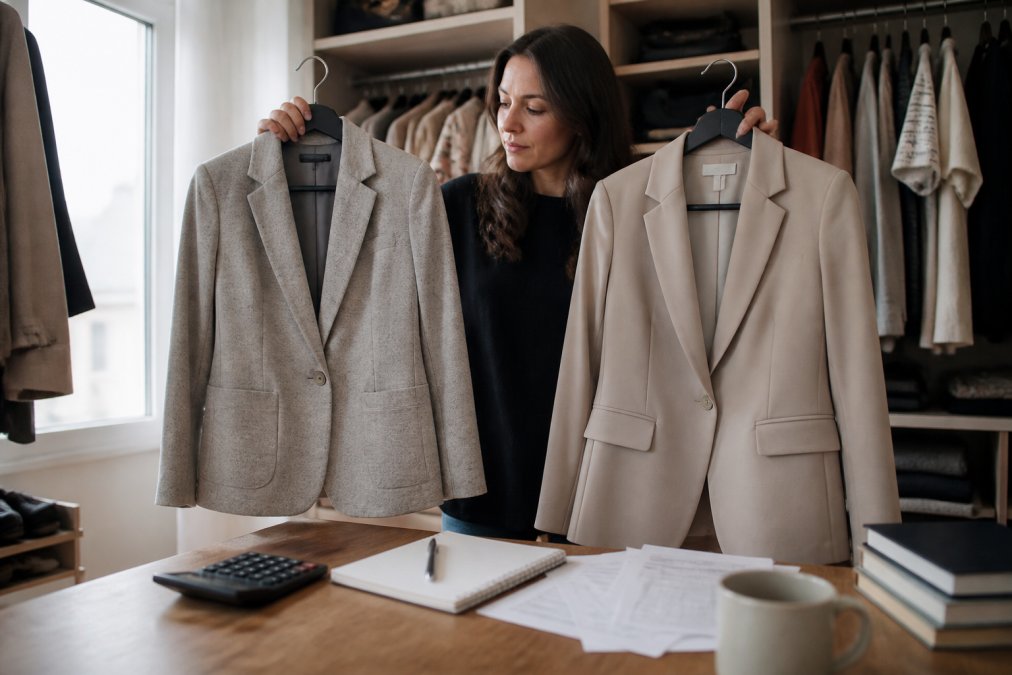
Here's how the math plays out in practice:
- A fast-fashion blazer you wear 10 times before it pills and loses shape
- An affordable luxury blazer you wear 100 times over three years
- The second blazer can cost several times more upfront and still deliver a lower cost per wear
The formula: Cost Per Wear = Purchase Price ÷ Number of Wears
Most shoppers only calculate the first number. A garment sitting unworn in your closet has an infinite cost per wear, no matter how cheap it was.
Pro Tip
Track your wears for one month on your five most-worn pieces. Most people discover they wear 20% of their wardrobe 80% of the time. That 20% is where your money should go.
Affordable Luxury Fashion Brands for Women: What Sets Them Apart
What separates affordable luxury from both fast fashion and traditional designer labels is intent. These brands build around durability, original design, and materials that hold up, then price the result below designer markup. ETHOS CONCEPT sits in this space with our Atelier Line of limited-edition pieces and our essentials collection, both designed for wardrobe longevity rather than one-season turnover.
The difference shows up in three places:
- Design philosophy: Original pieces instead of trend replication, so your wardrobe doesn't look like everyone else's
- Material sourcing: Natural fibers and quality blends instead of synthetic-heavy constructions
- Production scale: Limited runs that prioritize quality control over mass production volume
For women building a wardrobe that lasts, this tier offers the best balance of price, quality, and individuality. You're not paying for a logo. You're paying for a garment that still looks good in year three.
Key Takeaway
Affordable luxury isn't a compromise between cheap and expensive. It's a different value proposition: fewer, better pieces that earn their place in your closet.
Ethical Manufacturing and Environmental Footprint
Fast fashion's environmental footprint comes from volume: massive production runs, rapid trend cycles, and garments designed to be replaced quickly. Planned obsolescence is built into the model, producing a supply chain that prioritizes speed over labor standards and material quality.
Affordable luxury brands typically operate on slower schedules with smaller batches, meaning less overproduction, less waste, and more attention to ethical manufacturing. Transparency varies by brand, but the structural incentives push toward better conditions than fast fashion allows.
The Environmental Protection Agency's textile waste data shows how much clothing ends up in landfills each year. Longer-lasting garments directly reduce that number, because every year a piece stays in rotation is a year it isn't in a landfill.
Conscious consumption doesn't require perfection. It requires buying less and buying better, which is exactly what the affordable luxury model is built around.
Consumer Behavior and the Rise of Circular Economy Fashion
Consumer behavior has shifted toward circular economy models: resale, rental, and recycled extensions of existing garments. Shoppers increasingly weigh durability over pure trend-chasing, and wardrobe longevity is replacing fast cycles as a status signal.
This shift favors affordable luxury. Pieces built to last hold resale value. Investment pieces get worn for years, then passed on or resold instead of discarded. The FTC's guidance on textile labeling and care helps shoppers verify what they're actually buying, which supports more informed purchasing decisions across the market.
How the Resale Market Blurs the Line Between Luxury and Fast Fashion
Resale is the single biggest force reshaping how shoppers think about the luxury-versus-fast-fashion divide, and most comparisons ignore it. Here's the mechanism:
- Fast fashion loses value immediately. A trend piece bought at full price typically resells for a small fraction of what was paid, if it sells at all, because the same item is still available new and the design is already dated. The resale value is close to zero, which means the true cost of ownership is almost the entire purchase price.
- Affordable luxury holds value. A well-made piece from a brand with consistent quality and limited production runs can resell for a meaningful share of its original price, especially if it's a classic silhouette in good condition. That resale value effectively lowers the cost of ownership, you recoup part of what you paid when you're done with it.
- Designer luxury holds the most value but at a higher entry cost. The resale premium on heritage labels is real, but the upfront price puts it out of reach for most shoppers. Affordable luxury captures much of the resale benefit at a fraction of the entry price.
The practical takeaway: when you factor in resale value, the gap between affordable luxury and fast fashion widens further than the price tags suggest. A fast-fashion item's true cost is its full price; an affordable luxury item's true cost is its price minus what you recover on resale.
How to Participate in the Circular Economy Without Overthinking It
You don't need to become a resale expert. A few habits capture most of the benefit:
- Buy pieces you'd be willing to resell. If you can't imagine someone else wanting the item in two years, it probably won't hold value for you either.
- Keep original packaging and tags when practical. Resale platforms price higher for items with original materials, and buyers trust listings more.
- Learn basic repair. Replacing a button, rehemming a skirt, or reweaving a small moth hole extends wear life and preserves resale value. A $15 repair on a $150 garment is almost always worth it.
- Sell or donate rather than discard. Even worn items have a second life through textile recycling, which keeps them out of landfills longer than throwing them away.
- Consider rental for occasion wear. For a garment you'll wear once or twice, renting is often cheaper and more sustainable than buying, and it sidesteps the fast-fashion trap of buying something disposable for a single event.
What This Means for Your Wardrobe Strategy
The circular economy doesn't replace the affordable luxury argument, it reinforces it. A garment that holds resale value was built to last, and one built to last is one you'll want to wear for years. The resale market is a public scoreboard for durability.
Brand equity here comes from consistency, not hype. A brand that delivers the same quality season after season builds trust a trend-replication model can't match, and that trust shows up in resale prices.
Key Takeaway
The resale market is the clearest test of whether a garment was worth buying. If it holds value, it was built to last. If it doesn't, it was built to be replaced.
Conclusion
The choice between affordable luxury and fast fashion isn't really about price. It's about whether you want a wardrobe that works for years or a rotating stack of pieces that wear out before the season ends. Cost per wear, material quality, and construction all point the same direction.
ETHOS CONCEPT was built for exactly this shopper: women who want bold, Italian-inspired streetstyle without the disposable-fashion trade-off. Our Atelier Line offers limited-edition pieces, our essentials collection covers the wardrobe foundations, and free shipping on orders over $150 makes building that wardrobe easier. Add to cart and start investing in pieces that earn their place.
Frequently Asked Questions
Are luxury brands considered fast fashion?
Not all luxury brands are fast fashion, but some operate on similar seasonal drop cycles. True affordable luxury focuses on craftsmanship, material quality, and timeless design rather than rapid trend replication. Fast fashion prioritizes speed and low price points, often using synthetic fibers and planned obsolescence. The key difference is whether a brand designs for wardrobe longevity or for disposable fashion cycles.
What is the 3-3-3 rule in fashion?
The 3-3-3 rule suggests that a well-made garment should last at least three years, cost no more than three times your average fast-fashion purchase, and be worn at least three times per month. This framework helps shoppers evaluate cost per wear and avoid impulse buys. It encourages investment pieces over trend-driven purchases, supporting conscious consumption and reducing environmental footprint.
How can you tell if a garment is high quality?
Check the material tag first: natural fibers like cotton, linen, and wool generally outperform synthetic fibers in durability and breathability. Inspect stitching, seams should be tight and consistent, with no loose threads. Look for reinforced stress points at buttons, zippers, and pockets. Feel the fabric weight; flimsy material often signals lower material quality. These checks help identify high-quality clothing before you commit to a purchase.
What brands are not fast fashion but affordable?
Brands that prioritize ethical manufacturing, supply chain transparency, and durable materials fall into this category. ETHOS CONCEPT, for example, offers bold streetstyle and elevated essentials through its Atelier Line, blending affordability with craftsmanship. Other options include direct-to-consumer slow fashion labels that skip traditional retail markups. Look for brands that publish production details and focus on cost per wear rather than trend cycles.
Why is fast fashion considered unsustainable?
Fast fashion relies on mass production, synthetic fibers, and rapid trend replication, which drives disposable fashion and a large environmental footprint. Garments are designed for short lifecycles, contributing to planned obsolescence and textile waste. Labor standards in fast fashion supply chains are often opaque, raising ethical concerns. In contrast, affordable luxury emphasizes durability, ethical manufacturing, and circular economy practices like resale and recycling.