

Table of Contents
- What Limited Edition Fashion Actually Means
- The Psychology Behind Limited Edition Purchases
- Resale Value of Limited Edition Clothing: Real Market Data
- Is Limited Edition Clothing a Good Investment?
- Quality, Craftsmanship, and Mass Production: What You're Actually Paying For
- How to Spot Fake Limited Edition Fashion
- Is Limited Edition Fashion Worth It? The Honest Verdict
Last Updated: August 10, 2026
What Limited Edition Fashion Actually Means
Limited edition fashion refers to clothing and accessories produced in deliberately restricted quantities to create scarcity and exclusivity. Unlike mass-produced items available indefinitely, limited editions are released in finite runs, sometimes just a few hundred units, before being retired permanently.
True limited edition fashion combines restricted supply with deliberate design choices: unique aesthetics, premium materials, or designer collaborations that distinguish these pieces from everyday wear. ETHOS CONCEPT's Atelier Line exemplifies this approach, offering curated limited edition pieces that blend bold streetstyle with sophisticated craftsmanship, ensuring each collection feels genuinely exclusive.
The psychology embedded in scarcity is what makes limited editions compelling. When a brand announces only 500 units will exist, that number triggers a specific consumer response: the piece becomes a collectible with perceived rarity that may appreciate rather than depreciate. This transforms the purchasing decision from "Do I like this?" to "Will I regret not owning this?"
Pro Tip
The most successful limited editions are memorable. A piece people forget about isn't worth hunting down. Limited edition pieces that resell strongly years later share one trait: they had a distinctive visual identity that made them instantly recognizable. Generic designs with artificial scarcity don't hold value.
The Psychology Behind Limited Edition Purchases
Consumer psychology around limited edition items operates on FOMO, fear of missing out. When you encounter a piece marked as limited, your brain processes two competing signals: desire for the item and anxiety about its permanent unavailability. That anxiety often overrides rational evaluation of whether you actually need the piece or whether the price justifies the purchase.
Scarcity has signaled value across human cultures for centuries. Modern fashion brands engineered this principle into their business model, creating artificial scarcity to trigger the same psychological response that naturally scarce goods generate.
The emotional connection deepens when limited edition pieces succeed. Owning something only 500 people on Earth possess creates a sense of belonging to an exclusive group. This emotional attachment drives brand loyalty far more effectively than functional superiority. A woman who owns a limited edition piece from ETHOS CONCEPT's collection doesn't just own clothing; she owns a marker of her individual taste and membership in a community of people who value bold, distinctive style.
Not every limited edition piece is genuinely scarce. Some brands produce what they call "limited editions" in quantities of 2,000 or 5,000 units, creating the perception of exclusivity without actual supply constraints. Understanding this distinction helps you evaluate whether you're paying for genuine rarity or the feeling of rarity.
Collector mentality emerges when limited editions develop secondary markets. Once people begin reselling pieces at markups, the original purchase transforms psychologically from consumption to investment. This speculative element attracts buyers who view the purchase through a financial lens rather than a purely aesthetic one.
Watch Out
Impulse purchases of limited edition items often lead to buyer's remorse. The urgency created by scarcity messaging can override your actual style preferences. If you wouldn't buy it at regular price without the "limited" label, you probably shouldn't buy it at all.
Resale Value of Limited Edition Clothing: Real Market Data
The resale market for limited edition fashion has become increasingly sophisticated. Understanding resale value requires separating pieces that genuinely appreciate from those that depreciate like standard clothing.
Designer reputation matters significantly. Pieces from established luxury houses or renowned collaborators hold value far better than limited editions from lesser-known brands. The designer's prominence, history of producing collectible pieces, and strength of their brand following all influence secondary market pricing.
Condition preservation directly impacts resale value. Limited edition pieces that remain unworn or minimally worn command premiums on resale platforms. A piece with visible wear, stains, or damage loses value rapidly regardless of how limited it was. This creates a paradox: pieces you buy as investment vehicles often shouldn't be worn.
Production numbers within the limited run matter more than absolute scarcity. A piece produced in 50 units resells at higher multiples than one produced in 500 units, assuming equal demand. However, demand itself is unpredictable. A 500-unit piece from a hyped collaboration can resell for multiples of retail price, while a 50-unit piece from an unknown brand might sell for 60% of original price.
Limited edition pieces typically command the highest premiums immediately after selling out at retail. Prices often decline over 6-12 months as initial scarcity-driven demand subsides. However, pieces that achieve "cult status" can appreciate years later as collectors seek them out.
Authenticity verification has become critical for resale value. Counterfeit limited edition pieces flood secondary markets, depressing prices for authentic items. Pieces purchased directly from ETHOS CONCEPT or verified retailers carry authentication weight that pieces from unknown sources lack.
Is Limited Edition Clothing a Good Investment?
Evaluating limited edition fashion as an investment requires honest assessment of appreciation probability versus the certainty of depreciation. The data suggests that treating limited edition pieces as financial investments is generally a losing proposition for most buyers.
To break even on a limited edition piece purchased at a 30% premium, the piece would need to appreciate 30% on the secondary market. That appreciation is rare. Most pieces depreciate 40-60% within a year. Even pieces that eventually appreciate often take 3-5 years to reach break-even pricing.
Some limited edition pieces do appreciate substantially. Pieces from sold-out collaborations between major designers and luxury brands, particularly those involving streetwear or contemporary art crossovers, have demonstrated strong resale appreciation. However, these are outliers, not the norm. Predicting which pieces will achieve iconic status is nearly impossible at purchase time.
The opportunity cost of treating limited editions as investments is significant. Money spent on a limited edition piece that depreciates 50% could have been invested in index funds, which historically return 10% annually. Over five years, that's the difference between a $500 piece worth $250 and the same $500 growing to $805.
However, limited edition fashion can be a sound personal investment if you reframe the question. Instead of asking "Will this appreciate?", ask "Is the premium price worth the satisfaction of owning something unique?" If you genuinely value the exclusivity and distinctive design, the premium might be justified as a personal luxury rather than a financial investment.
Key Takeaway
Limited edition fashion is rarely a good financial investment. Most pieces depreciate 40-60% within a year. Treat limited editions as personal luxury purchases, not financial vehicles.
Quality, Craftsmanship, and Mass Production: What You're Actually Paying For
The quality difference between limited edition and mass-produced clothing is real but often overstated. Limited edition pieces typically use higher-grade materials than equivalent mass-produced items. A limited edition streetwear piece might use premium cotton blends or technical fabrics, while the mass-produced equivalent uses standard cotton.
Craftsmanship and construction methods differ in ways that affect longevity. Limited edition pieces often feature reinforced seams, higher stitch counts, and more careful finishing work. A mass-produced piece might have 8 stitches per inch; a limited edition piece might have 12. Over the garment's lifetime, that difference affects durability.
Design attention represents a significant cost difference. Limited edition pieces typically involve more design iteration, more careful fitting, and more distinctive aesthetic choices. This design attention is real value, but whether it justifies a 100% price premium is a personal decision.
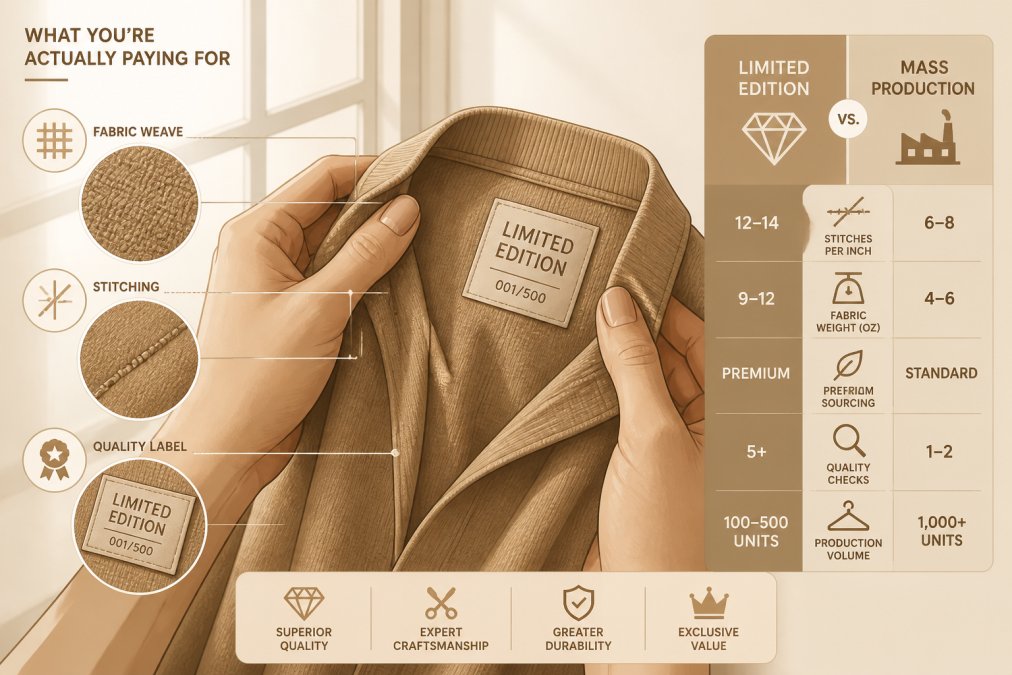
Quality perception often exceeds actual quality differences. The scarcity messaging and premium pricing create a psychological expectation that the piece is superior. When you pay $200 for a limited edition item, you expect it to be noticeably better than an $80 mass-produced equivalent. That expectation influences how you perceive the piece.
ETHOS CONCEPT positions its Atelier Line around this quality-craftsmanship intersection: pieces designed with careful attention to detail and constructed with materials that justify the premium. The brand's approach combines bold aesthetic choices with genuine construction quality, creating pieces that deliver on the promise of limited edition exclusivity.
How to Spot Fake Limited Edition Fashion
Counterfeit limited edition pieces represent a growing problem in the secondary market. Learning to identify fakes protects your wallet and ensures your purchase delivers the exclusivity you're paying for.
Authentication begins with the source. Pieces purchased directly from the brand or authorized retailers carry the lowest counterfeit risk. ETHOS CONCEPT's official channels and verified retailers provide documentation and traceability that secondary market purchases cannot match.
Documentation matters significantly. Authentic limited edition pieces often include certificates of authenticity, numbered tags, or serial codes. Authentic certificates use high-quality printing, precise fonts, and tamper-evident features. Fake certificates often show signs of low-quality reproduction: blurry text, color inconsistencies, or obvious printing defects.
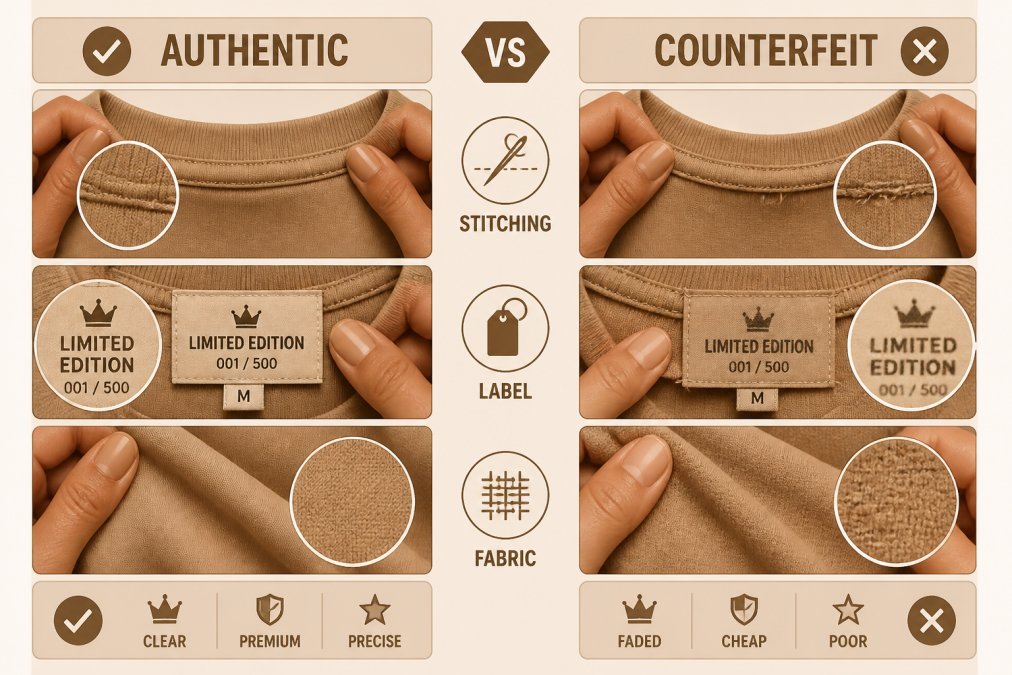
Label and tag examination reveals substantial differences. Authentic limited edition pieces feature precise, clean label printing with consistent font weights and spacing. Counterfeit labels often show printing irregularities: uneven ink saturation, misaligned text, or color variations. Counterfeit stitching is often loose, crooked, or uses different thread colors.
Fabric quality and weight provide tactile authentication clues. Authentic limited edition pieces use materials specified during design, creating consistent weight, drape, and texture. Counterfeiters substitute cheaper materials to reduce production costs, which changes how the fabric feels and behaves.
Stitching consistency indicates authenticity. Examine seams throughout the piece. Authentic construction features even stitch length, proper tension, and reinforcement at stress points. Counterfeit pieces often show inconsistent stitch patterns, loose threads, or skipped stitches.
Serial numbers and tracking systems provide verifiable authentication. Many brands now use blockchain or QR code verification systems. If a piece claims to have a serial number, verify it through the brand's official system. Counterfeiters cannot replicate functioning verification systems.
Price anomalies suggest counterfeiting. If a limited edition piece is available at 50% below secondary market pricing, investigate carefully. Dramatically discounted pieces are either counterfeit or stolen.
Watch Out
Buying counterfeit limited edition pieces has real consequences. Beyond the immediate financial loss, you're supporting criminal operations that profit from brand theft. Purchasing counterfeit goods is illegal in most jurisdictions. If you discover you've purchased a counterfeit piece, report it to the brand and the platform where you purchased it.
Is Limited Edition Fashion Worth It? The Honest Verdict
The answer depends entirely on what you're actually buying. If you're buying limited edition fashion as a financial investment expecting appreciation, the data suggests you shouldn't. Most pieces depreciate substantially, and predicting which pieces will appreciate is nearly impossible.
However, if you're buying limited edition pieces because you genuinely value the exclusivity, distinctive design, and quality of construction, the value proposition changes. You're purchasing a personal luxury item that makes you feel confident and distinctive.
The most honest evaluation requires asking yourself three questions:
First, would you buy this piece at regular retail price without the "limited" label? If the answer is no, you're buying primarily for scarcity, not for the piece itself. That's a warning sign.
Second, will you actually wear this piece regularly? Limited edition pieces that sit in closets unworn represent wasted resources and money. The premium pricing only makes sense if you're going to enjoy the piece through regular use.
Third, are you aware of the resale reality? Most pieces depreciate 40-60% within a year. Plan to absorb that loss rather than expect recovery.
For the right buyer with the right piece, limited edition fashion delivers value. ETHOS CONCEPT's approach, combining bold, distinctive design with genuine quality craftsmanship, creates pieces that justify the premium for buyers who value those qualities. The Atelier Line offers limited editions specifically designed for women who prioritize individuality and quality over mass-market trends.
The critical distinction is between buying limited edition pieces as a consumer making a personal luxury purchase versus buying them as an investor expecting financial returns. The former can be justified; the latter rarely is. Be honest about which category you fall into, and make your purchasing decisions accordingly.
Limited edition fashion is worth it when you're buying for the right reasons: you love the design, you value the quality, you'll wear it regularly, and you're comfortable with the financial reality that most pieces depreciate. If you're chasing scarcity for investment returns or buying primarily because of FOMO, you're likely making a mistake. The pieces that deliver genuine value are those where the limited edition status amplifies an already-excellent design, not pieces where scarcity is the primary appeal.
Frequently Asked Questions
Does limited edition fashion actually hold its resale value?
Resale value depends heavily on brand reputation, designer collaboration, and demand. Pieces from established brands with strong secondary markets can retain 30-60% of original value, while trend-driven items often drop to 10-20%. Designer collaborations and collectible pieces appreciate faster than standard limited runs. Check platforms like Depop and Vestiaire Collective to verify demand before buying with resale in mind.
What makes a limited edition piece a good investment?
Investment-grade limited edition clothing typically features designer collaborations, unique aesthetic appeal, sustainable production methods, and strong brand equity. Pieces with documented scarcity, quality craftsmanship, and emotional resonance tend to maintain value better. However, most limited edition fashion is worth buying for personal enjoyment rather than financial returns. Treat investment potential as a bonus, not the primary reason for purchase.
How can I tell if a limited edition piece is authentic?
Verify authenticity by checking serial numbers, hologram labels, and packaging quality against the brand's official specifications. Examine stitching precision, fabric weight, and hardware finishing. Purchase directly from authorized retailers like ETHOS CONCEPT to eliminate counterfeit risk. Be skeptical of significantly discounted limited editions on third-party sites, if the price seems too low, the piece likely isn't genuine.
Is paying more for limited edition fashion worth it compared to fast fashion alternatives?
Limited edition pieces from quality retailers offer superior durability, unique design, and better resale potential than fast fashion. While prices are higher upfront, the longevity and exclusivity justify the investment for style-conscious buyers who wear items regularly. Fast fashion may cost less initially but falls apart faster and offers no collectibility. The decision depends on your priorities: immediate savings or long-term value and individuality.
This article was written using GrandRanker