

Table of Contents
- Start With Fit at the Shoulder
- Oversized Blazer Outfit Ideas 2026
- Balance Proportions With Fitted Bottoms
- Blazer and Sneaker Street Style Combinations
- Luxury Streetstyle Trends 2026: What to Wear Now
- Body-Type Styling and Capsule Wardrobe Integration
- Common Mistakes to Avoid
- Frequently Asked Questions
Last Updated: September 14, 2026
Start With Fit at the Shoulder
The single most important rule for how to wear an oversized blazer street style 2026 comes down to one measurement: the shoulder seam. If that seam drops more than 5 centimeters past your natural shoulder point, the jacket stops looking intentional and starts looking borrowed (pubmed.ncbi.nlm.nih.gov).
This guide from ETHOS CONCEPT walks through the outfit formulas, proportions, and styling decisions that separate a polished oversized look from a shapeless one. Get the shoulder right and everything else falls into place.
Here's what most guides get wrong: they treat "oversized" as one fixed silhouette. It isn't. A structured oversized blazer with defined shoulders reads completely differently from a soft, unstructured drape. The first gives you architectural presence. The second gives you relaxed volume. Both work, but they demand different styling.
Check three things before you commit to a blazer:
- Shoulder seam: Should sit at or just past your natural shoulder, never halfway down your upper arm
- Sleeve length: Hem should hit at the wrist bone, not swallow your hands
- Body width: You should be able to fit one fitted layer underneath without the fabric pulling
A common mistake is sizing up two or three sizes for maximum volume. That's not oversized, that's ill-fitting. True oversized tailoring is cut with extra room built into the pattern, not borrowed from a larger size.
Pro Tip
Pinch the fabric at the back of the shoulder. If you can pull more than 2.5 centimeters of excess, the shoulder is too wide and no amount of styling will fix the silhouette.
Oversized Blazer Outfit Ideas 2026
The strongest oversized blazer outfit ideas 2026 share one principle: create contrast. Pair volume with structure, or volume with minimalism. Never volume with more volume.
The Cinched-Waist Formula
A cinched waist transforms an oversized blazer into a defined silhouette. Belt it at your natural waist over a fitted base layer, and the jacket becomes a dress-like statement piece. This works especially well with longer blazers that hit mid-thigh.
The trick is belt width. A wide belt (5-7 centimeters) holds the blazer fabric flat and creates a clean line (Is It Time for the Return of Wide Belts?). A thin belt gets lost in the volume. Choose leather or a structured material that won't collapse under the jacket's weight.
The Minimalist Underlayer
Strip everything back. A plain fitted tank, a fine-knit turtleneck, or a simple slip dress under an oversized blazer lets the outerwear do the talking. This is the easiest way to make the look feel deliberate rather than accidental.
Keep underlayers close to the body. Loose pieces underneath add bulk where you don't want it, and the whole ensemble starts reading as "wearing someone else's clothes" instead of "styled with intention."
Key Takeaway
One volume per outfit. If the blazer is oversized, everything underneath stays fitted. This single rule solves most styling problems before they start.
Balance Proportions With Fitted Bottoms
Fitted bottoms are the fastest way to balance an oversized top half. The contrast between a roomy blazer and a slim trouser or pencil skirt creates a deliberate silhouette rather than a boxy one.
Straight-leg or slim tailored trousers work best. So do fitted midi skirts and slim jeans. What you want to avoid is wide-leg pants paired with a wide blazer, unless you're specifically going for a full-volume editorial look and you know how to break it up with a belt or a cropped underlayer.
Proportion is about the ratio between your top and bottom halves. When the blazer adds width above the waist, narrowing the below-the-waist line restores visual balance. This is why the same blazer can look sharp with slim trousers and sloppy with baggy ones.
For a transitional look that works from office to evening, try a fitted column skirt in a neutral tone under a structured oversized blazer. Add a slim belt. The result reads polished without losing the relaxed street style edge.
Blazer and Sneaker Street Style Combinations
Blazer and sneaker street style combinations work when the sneaker matches the formality level of everything else. A clean leather sneaker under a tailored blazer looks intentional. A chunky running shoe under the same blazer looks like you forgot to change shoes.
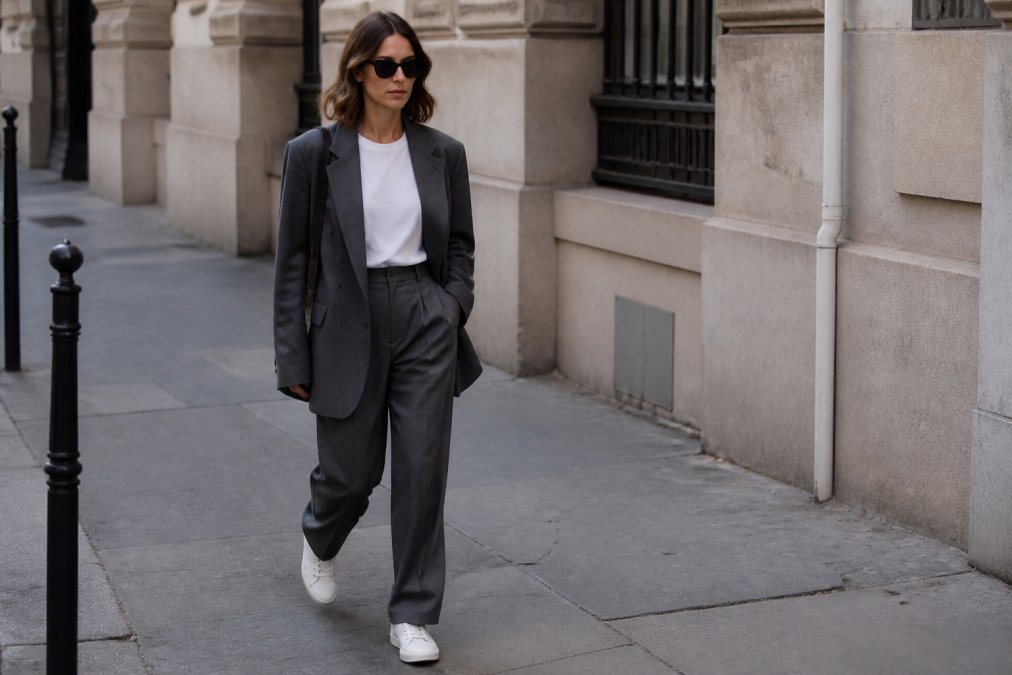
The formula that holds up best:
- Structured blazer + slim trousers + low-profile leather sneaker, the classic smart-casual combination
- Oversized blazer + fitted midi dress + minimal white sneaker, softer, more feminine, works for daytime events
- Belted blazer + straight jeans + retro court sneaker, relaxed but deliberate
Match your sneaker's color to something in the outfit. White sneakers with a white underlayer. Black sneakers with black trousers. This small detail makes the whole ensemble look considered rather than thrown together.
The Hem-Break Rule That Fixes Most Sneaker Outfits
The single most common reason a blazer-and-sneaker look fails is the trouser hem. A slim trouser that pools over a sneaker reads sloppy; the same trouser cropped to just kiss the top of the shoe reads sharp (How Your Dress Pants, Jeans, and Chinos Should Fit: A Primer). Aim for a hem that breaks once, lightly, at the ankle, or a clean crop that shows a sliver of ankle or sock. If your trousers were tailored for heels, have them shortened before pairing them with sneakers. This one alteration does more for the look than any accessory.
Shoe Silhouettes That Work (and Why)
- Low-profile leather sneakers (think the classic tennis-shoe shape): the safest pairing. The thin sole keeps the visual weight at the blazer, where you want it.
- Retro court sneakers: slightly chunkier, but the flat sole and clean upper still read as smart-casual. Best with straight-leg denim or a belted blazer.
- Minimal white sneakers: the most versatile. They lighten a dark blazer and echo a white underlayer.
- Canvas plimsolls: work only with the most casual pairings, denim, a tee, an open blazer. Skip them with tailoring.
Socks, Ankles, and the Details That Sell It
Sock choice is where the outfit is won or lost. No-show socks keep the line clean with cropped trousers and bare ankles. A fine ribbed sock in a color pulled from the outfit, cream, charcoal, navy, adds a deliberate layer and bridges the gap between a cropped hem and the shoe. Avoid thick athletic crew socks unless the entire outfit is deliberately sporty.
Watch Out
Avoid pairing an oversized blazer with chunky athletic sneakers unless the rest of the outfit is deliberately sporty. The contrast between formal tailoring and performance footwear reads as a mistake, not a choice.
Day-to-Night Swap
The same blazer-and-sneaker base transitions easily. Keep the blazer and trousers, swap the sneaker for a sleek loafer or a low boot, and the outfit moves from daytime street style to evening. This is why a neutral blazer and one well-fitting trouser are worth more than three trend pieces.
Key Takeaway
Pick the sneaker first, then tailor the trouser hem to it. The shoe sets the formality; the hem makes it look intentional.
Luxury Streetstyle Trends 2026: What to Wear Now
Luxury streetstyle trends 2026 lean toward quiet structure over loud logos. The most fashion-forward looks this year pair oversized tailoring with minimal accessories and let the silhouette carry the statement.
Three directions dominate right now:
- Soft neutrals: Cream, camel, and warm grey blazers styled with tonal underlayers
- Sharp contrast: Black oversized blazers over white or pale separates for maximum definition
- Textural mixing: Wool blazers layered over silk or fine knit for depth without color noise
The oversized blazer has become a genuine wardrobe staple because it works across seasons. In warmer months, wear it open over a slip dress. In cooler months, layer it over a turtleneck and add boots. The same jacket, two completely different aesthetics.
What separates a trend-driven look from a timeless one is restraint. Skip the logo-heavy accessories. Let the tailoring and the drape do the work.
Body-Type Styling and Capsule Wardrobe Integration
Body-type specific styling is where most oversized blazer guides fall short, and it's the difference between a look that flatters and one that overwhelms. The goal isn't to hide your frame, it's to place the volume where it works and keep a clear vertical line everywhere else.
Body-Type Styling With Measurement Anchors
For petite frames (roughly under 5'4"): Choose a shorter oversized blazer that ends at the high hip, around the top of your hip bone. Longer jackets cut your vertical line. Keep the shoulder seam precise (no more than about 2.5 centimeters past your natural shoulder) and pair with slim or straight bottoms. A monochrome column, blazer, top, and trouser in the same tonal family, adds height without heels.
For taller frames (roughly over 5'9"): You can carry longer, wider blazers with ease. Mid-thigh and knee-length oversized styles suit you, and wide-leg trousers won't overwhelm your proportions. Use a belt to break up a long line if you want waist definition.
For curvy frames: Look for blazers with a defined shoulder and enough room through the waist to avoid pulling, check by buttoning the jacket and sliding a flat hand under the fabric at the waist. Belt at your natural waist to create structure. A structured fabric (wool, a wool blend, or a bonded cotton) holds its shape better than a soft drape here.
For straight or athletic frames: Soft, unstructured oversized blazers add curve and movement. Cinch with a belt to create waist definition where you want it, or layer over a slip dress to introduce a softer line.
The Tailoring Fixes Worth Paying For
Off-the-rack oversized blazers rarely fit perfectly, and a few small alterations change everything:
- Shorten the sleeve so the hem hits at the wrist bone. This is the most common and most worthwhile fix.
- Take in the shoulder if the seam drops too far, a tailor can sometimes reduce it by a small amount, but if it's more than a couple of centimeters off, size down instead.
- Nip the waist slightly on structured blazers to keep the oversized look intentional rather than boxy.
Most practitioners find that one or two alterations, sleeve length and a light waist nip, do more for an oversized blazer than buying a more expensive one off the rack.
Capsule Wardrobe Integration
An oversized blazer earns its place in a capsule because it's genuinely versatile. One well-chosen blazer can anchor a smart-casual outfit, dress up denim, and layer over evening wear. A practical approach is to build around two or three blazers in neutral tones, for example, one black, one camel or cream, and one in a bolder color or texture, then rotate them across a small set of fitted underlayers and bottoms.
A simple ten-piece capsule that supports the oversized blazer look:
- One structured oversized blazer (neutral)
- One softer oversized blazer (texture or color)
- Two fitted tanks or fine-knit tops
- One fitted turtleneck
- One slip dress
- One slim tailored trouser
- One straight-leg jean
- One fitted midi skirt
- One wide belt
- One low-profile sneaker and one loafer
With this base, the same blazer produces a different outfit every day of the week, which is exactly why it's the highest-value piece in a capsule.
Pro Tip
For fabric care, hang your blazer on a wide-shouldered hanger immediately after wearing. This preserves the shoulder structure and lets the wool recover its shape. Dry clean sparingly, spot clean between wears, and steam rather than iron to protect the drape.
Key Takeaway
Style for your frame first, tailor the two details that matter (sleeve and waist), then let one blazer do the work of five outfits.
Common Mistakes to Avoid
The most common mistake is confusing oversized with ill-fitting. An oversized blazer should look deliberately roomy, not like you grabbed the wrong size off the rack.
Other frequent errors:
- Too much volume everywhere. Wide blazer plus wide pants plus chunky shoes equals a shapeless silhouette.
- Ignoring the shoulder. No amount of styling rescues a blazer whose shoulder seam sits halfway down your arm.
- Over-accessorizing. An oversized blazer is already a statement. Heavy jewelry competes with it.
- Wrong underlayer bulk. Thick sweaters under a roomy blazer add mass where you need definition.
- Skipping the waist. Without some waist definition, a long oversized blazer can read as a shapeless coat.
The fix for most of these is contrast and restraint. Pick one volume, one statement, and let the rest of the outfit support it.
Building a wardrobe that carries an oversized blazer with confidence takes the right foundation pieces, and that's where ETHOS CONCEPT comes in. Our curated collections, from the limited-edition Atelier Line to versatile essentials, give you the structured tailoring, minimalist underlayers, and fitted separates that make every oversized look work. With free shipping on orders over $150, discovering your next wardrobe staple is straightforward. Explore the ETHOS CONCEPT collection and add to cart the pieces that let you wear volume on your own terms.
Frequently Asked Questions
Are oversized blazers still in style in 2026?
Yes. The oversized blazer remains a wardrobe staple for 2026, moving beyond a simple trend into a core piece of modern street style. This year's versions lean toward sharper tailoring, softer drapes, and structured shoulders that hold their shape. The key shift is styling: instead of drowning in volume, you balance the silhouette with fitted bottoms, cinched waists, or minimalist underlayers. It reads as polished and effortless rather than sloppy.
How do I balance proportions when wearing an oversized blazer?
The rule is volume against volume. If the blazer is oversized, keep the bottom fitted or tailored. Think slim straight-leg trousers, a mini-dress, or leggings. Alternatively, cinch the waist with a belt to define your shape while keeping the shoulders relaxed. Avoid pairing an oversized blazer with wide-leg pants unless the fabric is lightweight and the fit is intentional. Balance is what makes the look chic instead of overwhelming.
Can I wear an oversized blazer to the office or professional settings?
Absolutely. An oversized blazer works for professional settings when the styling is deliberate. Choose a structured blazer in a neutral tone, pair it with tailored separates like a pencil skirt or straight-leg trousers, and keep underlayers minimal. Avoid distressed denim or loud graphics. The blazer's tailoring and fabric quality signal polish, so it transitions from smart-casual to business casual without effort. Add loafers or sleek sneakers to complete the ensemble.
What accessories work best with an oversized blazer silhouette?
Accessories should complement, not compete. A slim belt cinched at the waist adds structure and breaks up volume. Minimalist jewelry, like a thin chain or small hoops, keeps the focus on the blazer's cut. A structured bag balances the relaxed fit. For footwear, clean sneakers or pointed-toe flats work for daytime, while heeled boots add height for evening. Avoid bulky scarves or oversized bags that add unnecessary volume.