

Table of Contents
- Start With a Capsule Wardrobe Essentials Foundation
- The 3-3-3 Rule: A Simple Framework for Mixing High-End Fashion
- How to Make Cheap Clothes Look Expensive With Fit and Tailoring
- Fabric Pairings That Make High and Low Fashion Work Together
- Affordable Luxury Fashion Brands for Women: What to Look For
- Accessory Curation and Layering Techniques That Elevate Any Outfit
- Common Mistakes That Make Budget Pieces Look Cheap
- Conclusion
- Frequently Asked Questions
Last Updated: September 16, 2026
Start With a Capsule Wardrobe Essentials Foundation
Learning how to mix high-end and affordable fashion pieces starts with a foundation, not a shopping spree. A capsule wardrobe is a tightly edited collection of versatile, interchangeable pieces you wear often, and it gives every new addition a clear job to do. ETHOS CONCEPT offers versatile essentials designed to anchor an outfit rather than compete with it.
A common mistake is buying statement pieces first. Statements need something neutral to sit against, or they read as noise. Build the base layer first:
- One well-fitting blazer in a neutral tone
- Two pairs of trousers that hit the right break
- Three plain tops in colors that flatter your skin tone
- One pair of jeans cut for your actual proportions
- One simple dress or jumpsuit that works day to night
Get these right and the rest of your wardrobe becomes easier to assemble. The FTC's guidance on textile labeling and care is worth a look if you want to understand what fabric labels actually tell you before you buy.
The 3-3-3 Rule: A Simple Framework for Mixing High-End Fashion
The 3-3-3 rule is a styling framework for how to mix high-end and affordable fashion pieces: build each outfit from three investment pieces, three affordable pieces, and three accessories. It keeps any single price tier from dominating the look.
In practice, that might mean a tailored blazer, leather shoes, and a silk scarf as your investment tier; a cotton tee, denim, and a knit as your affordable tier; then a belt, earrings, and a bag to finish.
Pro Tip
Photograph your 3-3-3 combinations as you build them. A phone album of ten working outfits saves more morning time than any shopping app.
How to Make Cheap Clothes Look Expensive With Fit and Tailoring
Tailoring is the single highest-return change you can make to an affordable piece. A hem taken up, a waist taken in, or sleeves shortened to the right bone costs little and changes how the garment reads entirely.
| Problem | Fix | Impact |
|---|---|---|
| Sleeves too long | Shorten to wrist bone | Instantly sharper line |
| Waist gaping | Take in at side seams | Removes boxy look |
| Trousers pooling | Hem to a single break | Lengthens the leg |
| Buttons cheap-looking | Swap for metal or horn | Adds perceived value |
Fabric Pairings That Make High and Low Fashion Work Together
Texture contrast is what sells a mixed-price outfit, but the mechanism is simpler than most guides admit: the eye reads a whole look as "considered" when at least one fabric has visible surface variation, a sheen, a nap, a weave you can see from a few feet away. Pair a flat, matte affordable fabric with one that has visible quality, and the contrast does the work for you.
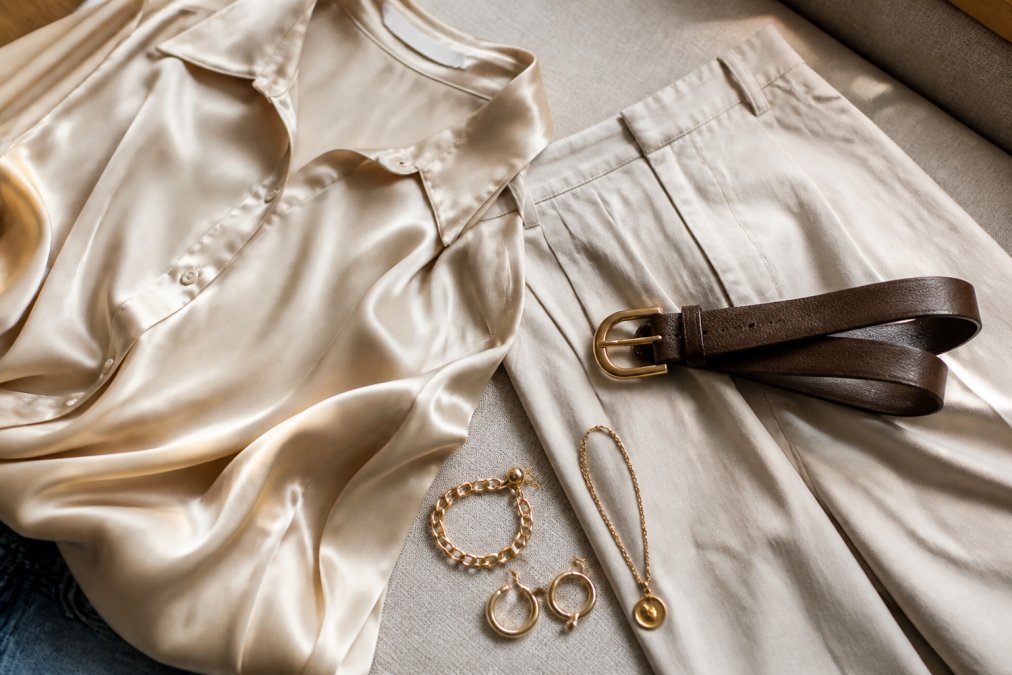
- Silk blouse with cotton-blend trousers. The silk catches light; the cotton absorbs it. The contrast makes the affordable trouser look intentional rather than plain.
- Wool coat over a synthetic knit dress. Wool has a natural loft and a slightly irregular surface. A smooth synthetic underneath makes the wool look richer by comparison.
- Leather belt on denim. Denim is one of the few affordable fabrics with real texture of its own, which is why it holds its own next to leather.
- Linen shirt with a structured blazer. Linen's visible slub reads as deliberate; a crisp tailored jacket keeps it from looking rumpled.
- Cashmere or merino knit with a cotton poplin shirt. The soft halo of the knit against the flat poplin is a classic high-low pairing that survives trend cycles.
The maintenance half nobody covers
Most guides stop at styling. The reason affordable pieces start looking cheap is usually not the fabric, it's what happens to the fabric after five washes. A few habits protect the investment:
- Wash less often. Most cotton and cotton-blend garments don't need a wash after every wear. Airing them overnight between wears extends the interval and slows pilling and fading.
- Turn knits inside out and use cold water. Heat and agitation are what break down fibers and cause pilling, not the fiber itself.
- Skip the dryer for anything with elastane. Heat degrades stretch fibers faster than anything else, which is why budget denim and tees lose their shape first.
- Use mesh bags for delicates and hardware. Zippers and buttons snag other garments in the wash; a mesh bag prevents the pilling that makes a whole load look tired.
- Store knits folded, not hung. Hanging stretches shoulders and creates the droop that reads as worn-out.
Key Takeaway
The pairing gets you the look on day one. The care routine is what keeps the affordable half of the outfit from giving the game away by month three.
Affordable Luxury Fashion Brands for Women: What to Look For
The best affordable luxury fashion brands for women share three traits: consistent sizing, honest fabric composition, and construction that survives repeat wear. Price alone tells you very little, a $40 blazer and a $400 blazer can both be a waste of money if the seams and lining don't hold up.
The splurge-vs-save cheat sheet
Most guides tell you to "invest in quality" without saying which items actually earn the investment. The honest answer is cost-per-wear: divide the price by the number of times you realistically expect to wear the piece. A $300 coat worn 100 times costs $3 per wear. A $60 trend top worn four times costs $15 per wear. The cheaper item is the more expensive one.
Use that math to sort your shopping list:
| Category | Splurge | Save | Why |
|---|---|---|---|
| Outerwear | ✔ | Worn daily in season; structure and fabric show immediately | |
| Shoes (leather) | ✔ | Resoleable; cheap soles crack and can't be repaired | |
| Bags | ✔ | Hardware and stitching are visible at a glance | |
| Denim | ✔ | Fit and fade behavior are hard to fake at low price points | |
| Knitwear | ✔ | Mid-tier merino and cotton blends perform close to luxury | |
| Tops and tees | ✔ | High turnover, high wash frequency; not worth premium | |
| Trend pieces | ✔ | By definition short-lived; cost-per-wear is low | |
| Statement jewelry | ✔ | Costume pieces read the same as fine at conversational distance |
What to check before you buy from an unfamiliar brand
- Return window. Fourteen days or fewer is a warning sign for a brand you haven't worn before.
- Fabric percentage on the label, not the marketing copy. "Premium blend" means nothing; "80% wool, 20% nylon" means something.
- Sizing consistency across the catalog. If a brand's size chart varies by product, you'll spend more on returns than you save.
- Whether the piece is a one-off or part of a repeatable line. Repeatable lines get restocked, which means you can replace a worn-out favorite instead of hunting for a substitute.
Watch Out
Buying "luxury" basics from an unfamiliar site without checking return terms is the fastest way to lose money. If the return window is short or unclear, treat it as a red flag.
Pro Tip
Before any splurge purchase, write the cost-per-wear estimate on your phone. If you can't honestly picture wearing it 30 times, it belongs in the save column.
Accessory Curation and Layering Techniques That Elevate Any Outfit
Accessories are the cheapest way to shift an outfit's register. A single statement accessory, worn with restraint, does more than five small ones competing for attention.
Common Mistakes That Make Budget Pieces Look Cheap
Most budget pieces fail for predictable reasons, and nearly all of them are fixable.
- Wearing wrinkled fabric, which reads as careless regardless of price
- Ignoring fit and hoping a belt will hide it
- Mixing too many trends in one outfit
- Choosing loud prints on low-quality fabric, which shows every flaw
- Skipping the tailor to save a small amount
Conclusion
Building a wardrobe that reads expensive without costing like it is a skill, and it takes practice. ETHOS CONCEPT offers a curated mix of bold streetstyle and affordable pieces, an exclusive Atelier Line of limited-edition designs, and free shipping on orders over $150. Start with the essentials, apply the 3-3-3 rule, and let tailoring and texture do the rest. Add to cart and build the wardrobe that actually sounds like you.
Frequently Asked Questions
What is the 3-3-3 rule in fashion?
The 3-3-3 rule is a styling framework for mixing high-end and affordable fashion pieces. It means building an outfit with three investment pieces, three budget-friendly items, and three accessories. This balance keeps the overall look elevated without overspending. For example: a tailored blazer, quality leather bag, and designer shoes paired with affordable trousers, a basic tee, and a high-street scarf. The ratio prevents any single price tier from dominating, so the outfit reads as intentional rather than expensive or cheap.
How do you mix high and low fashion without looking cheap?
Focus on fit and fabric first. A well-tailored affordable blazer in a structured fabric can sit beside a designer silk blouse without either looking out of place. Keep the color palette tight (two to three tones), let one piece be the focal point, and make sure everything is pressed and clean. Avoid mixing too many trends at once. The goal is outfit composition that looks deliberate. When affordable pieces fit properly and fabrics have visual interest, the price gap disappears to anyone watching.
Which items should you invest in versus save on?
Invest in pieces that carry the most visual weight and get the most wear: outerwear, shoes, handbags, and tailored jackets. These are the items people notice first and that define your silhouette. Save on trend-driven pieces, basic tees, and seasonal accents that rotate quickly. This approach lowers your cost-per-wear on investment pieces while keeping your wardrobe versatile. A quality coat worn 100 times costs less per wear than a cheap one replaced every season.
How can I make affordable clothes look like high-end designer pieces?
Start with tailoring. A $10 alteration on an affordable blazer often does more than spending triple on a new one. Swap plastic buttons for metal or horn, steam everything before wearing, and pair budget pieces with one genuine luxury item like a leather belt or structured bag. Fabric composition matters too: choose natural fibers or quality blends over thin synthetics. Finally, use accessory curation. A single statement accessory, such as a gold-tone necklace or silk scarf, shifts the entire outfit's perceived value upward.