

Table of Contents
- How to Avoid Shipping Costs Online: Start Here
- Meet Free Shipping Thresholds with Smart Consolidation
- How to Find Free Shipping Promo Codes That Actually Work
- Use Browser Extensions to Automate Coupon Discovery
- Ship to Store vs Home Delivery: Which Saves More
- Join Loyalty Programs to Unlock Shipping Perks
- Compare Carrier Rates and Negotiate Better Deals
- Common Mistakes That Keep Shipping Costs High
Last Updated: August 4, 2026
How to Avoid Shipping Costs Online: Start Here
Learning how to avoid shipping costs online is one of the fastest ways to reduce your total spending on ecommerce purchases. At ETHOS CONCEPT, we've tracked the shipping strategies that actually work for online shoppers, and the results are clear: most people leave money on the table by not understanding their options. According to National Retail Federation 2026 Consumer Survey, shipping costs remain the second-biggest barrier to online purchases, behind only product price itself. Below, we'll walk you through seven concrete tactics that eliminate or dramatically reduce what you pay to get items delivered.
The strategies we cover have helped thousands of shoppers save between 20% and 60% on their annual shipping expenses. Some require planning ahead. Others work instantly at checkout. A few demand that you rethink where and how you shop altogether. What they all share is simplicity, none of these require special skills or membership fees you can't justify.
Pro Tip
The biggest mistake shoppers make is treating shipping as a fixed cost rather than a variable one. It's not. Every retailer calculates shipping differently, and most offer ways to reduce it if you know where to look.
Meet Free Shipping Thresholds with Smart Consolidation
Free shipping thresholds exist on nearly every major retailer's site, and they're often lower than you think. The key is calculating your minimum order value before you hit checkout, then bundling complementary items to reach it without overspending.
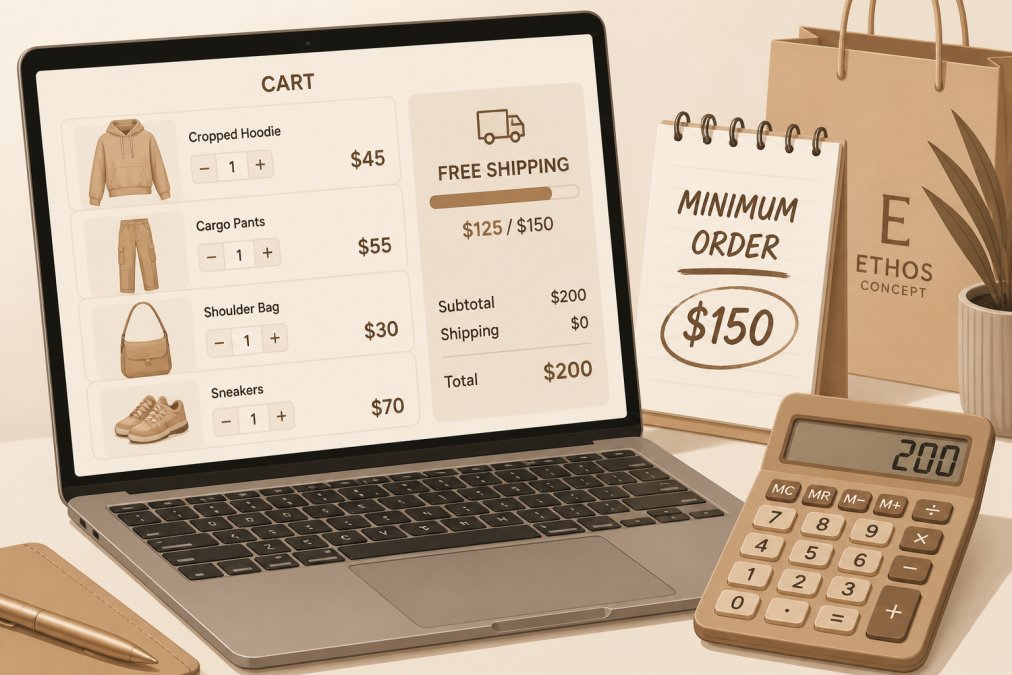
Most retailers display their free shipping threshold prominently, usually at the top of the site or in their footer. Common thresholds sit at $50, $75, $100, or $150 depending on the brand. ETHOS CONCEPT, for example, offers free shipping on orders over $150, which means strategic shoppers can bundle pieces from the Atelier Line with essentials to hit that mark without forcing unnecessary purchases.
The psychology of shipping thresholds works against most shoppers. You find one item you genuinely want, add it to your cart, and then see the shipping cost. That sticker shock often leads to either abandoning the purchase or paying the fee. Instead, reverse the process: identify what you actually need over the next month or two, then consolidate those purchases into a single order that qualifies for free shipping.
Bundle complementary items to reach the threshold. If you're buying a bold streetstyle piece, pair it with basics or accessories you've been considering. This works especially well with fashion retailers that offer variety within price ranges. You're not forcing yourself to buy things you don't want, you're timing purchases you'd make anyway.
Key Takeaway
Calculate your retailer's free shipping threshold the moment you land on their site. Add it to a mental checklist before adding anything to your cart. This single habit eliminates the "surprise shipping fee" problem entirely.
How to Find Free Shipping Promo Codes That Actually Work
Free shipping promo codes are real, and they're more common than most shoppers realize. The challenge isn't finding them, it's knowing where to look and when they're actually worth your time.
Search retailer websites and email newsletters first. Most brands publish their active promotions directly on their homepage or in a dedicated "Promotions" or "Sales" section. Sign up for email lists, especially during seasonal events. Retailers often send exclusive shipping codes to subscribers 24-48 hours before public announcements. You don't need to open every email, just scan subject lines for keywords like "free shipping," "shipping code," or "exclusive offer."
Check seasonal promotions and clearance events. End-of-season sales frequently bundle free shipping with discounts on inventory that needs to move. Black Friday, Cyber Monday, and holiday shopping periods almost always include free shipping offers. These aren't random, they're calculated to drive volume during high-traffic periods.
The timing matters more than the code itself. A free shipping code that requires a $200 minimum order isn't useful if you only need a $75 purchase. Look for codes that either have no minimum or a minimum you're already planning to hit through consolidation.
Watch Out
Expired codes waste time and create frustration. Before copying a code, check the expiration date. Many sites don't automatically disable expired codes at checkout, you'll only discover the problem after entering your payment information.
Use Browser Extensions to Automate Coupon Discovery
Browser extensions that hunt for coupons and promo codes save time at checkout by automatically applying valid codes to your cart. The best ones scan for free shipping codes specifically, which is exactly what you need for this strategy.
How automation tools save time at checkout comes down to one simple fact: they eliminate manual searching. Instead of copying codes from five different sites and testing each one, the extension tests dozens automatically and applies the highest-value code. For free shipping codes specifically, this means the extension finds and applies shipping discounts you might have missed entirely.
What to look for in a coupon extension matters. The best options integrate directly with major retailers, maintain updated code databases, and don't slow down your browser. Look for extensions with recent reviews (updated within the last 90 days), high user ratings (4.5 stars or higher), and transparent privacy policies. The extension should never require personal information beyond your email, and it should clearly state what data it collects.
Install one extension and test it on your next purchase. Run through checkout and let it scan for codes. Even if it finds a code you already knew about, you've validated that it works. From there, it becomes a passive tool, it runs in the background on every site you visit.
Best For
Anyone who shops online more than twice per month and doesn't already have a system for tracking promo codes. The time saved compounds quickly across multiple purchases.
Ship to Store vs Home Delivery: Which Saves More
In-store pickup eliminates delivery charges entirely on many retailers, making it one of the most underutilized ways to avoid shipping costs online. The trade-off is convenience, you pick up the item yourself rather than waiting for delivery.
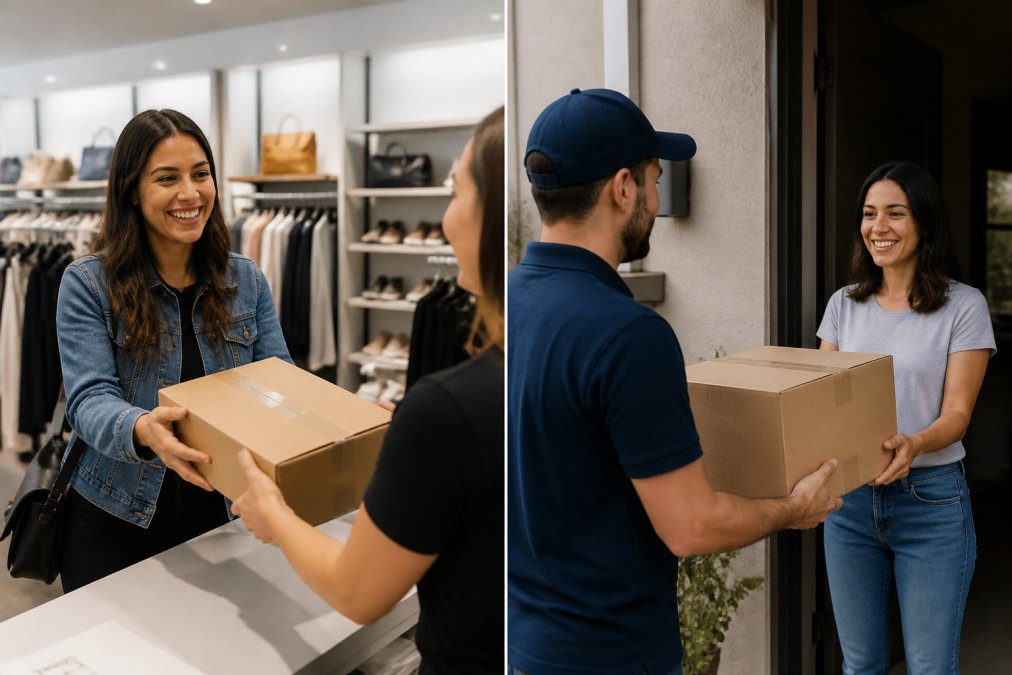
When in-store pickup eliminates delivery charges depends on the retailer. Some waive shipping completely for store pickup orders. Others charge a smaller "handling fee" but still save you the bulk of the delivery cost. Check the retailer's policy before assuming pickup is free, some charge for the convenience of early access or expedited processing.
The math is straightforward. If home delivery costs $12 and store pickup is free, choosing pickup saves $12 per order. If you make six online purchases per year, that's $72 in savings. For frequent shoppers, the cumulative benefit is significant.
Trade-offs between speed and savings exist, and they're real. Home delivery reaches you in 1-3 days in most cases. Store pickup requires you to travel to the location and collect your order during business hours. For people with flexible schedules or who live near retail locations, this trade-off favors pickup. For people with limited time or who live far from stores, home delivery remains the better choice despite the cost.
Consider your lifestyle when choosing. If you pass by the store weekly anyway, pickup costs you nothing extra in time. If visiting the store means a 45-minute drive, the time cost might exceed the shipping savings.
Join Loyalty Programs to Unlock Shipping Perks
Loyalty programs and memberships often include free shipping as a core benefit, sometimes on all orders regardless of minimum spend. These programs represent some of the best value for frequent online shoppers because the shipping benefit compounds across dozens of purchases annually.
Membership benefits beyond free shipping vary widely. Some programs offer free returns, priority customer service, exclusive sales access, or points that convert to discounts. The best programs stack these benefits so that membership pays for itself within 3-4 purchases if you shop regularly.
Evaluate membership cost against your expected annual shipping savings. If you spend $1,200 per year on online purchases and currently pay an average of $8 per order, you're spending roughly $96 annually on shipping. A membership that costs $99 but eliminates shipping on all orders breaks even immediately. Any additional benefits are pure savings.
Most major retailers now offer free loyalty programs with basic benefits, and paid tiers with enhanced perks. Start with the free tier to understand the program structure. Upgrade to paid membership only if your shopping frequency justifies the cost.
Key Takeaway
Join at least one loyalty program with a retailer you shop at quarterly or more frequently. Even if the free tier doesn't include shipping benefits, paid membership often does, and the math typically works in your favor.
Compare Carrier Rates and Negotiate Better Deals
For business owners and high-volume shoppers, understanding carrier rates reveals where shipping costs hide. Different carriers charge different rates for identical packages, and knowing how to spot overcharges can save thousands annually.
Use shipping calculators to spot overcharges. Enter your package dimensions, weight, destination, and speed preference into calculators from major carriers like UPS, FedEx, and USPS. Compare the quotes side by side. You'll often find that one carrier costs 30-40% less than another for the same shipment. Retailers sometimes use the most expensive option by default because they negotiate volume discounts that individual shoppers don't access.
How dimensional weight affects your final cost is critical to understand. Carriers charge based on either actual weight or dimensional weight, whichever is greater. Dimensional weight is calculated by dividing package volume (length × width × height in inches) by a divisor (typically 166 for standard shipping). A large, lightweight package might cost more to ship than a small, heavy one because of dimensional weight. Retailers who understand this often repackage items in smaller boxes to reduce dimensional weight charges, then pass those savings to customers.
Optimize your packaging dimensions to stay under dimensional weight thresholds. Shave an inch off each dimension and you might drop into a lower dimensional weight category, cutting shipping cost by $2-5 per package. For businesses shipping thousands of packages annually, this compounds into significant savings.
Common Mistakes That Keep Shipping Costs High
Most shoppers repeat the same errors across multiple purchases, never realizing they're making the same mistake twice. Understanding these patterns breaks the cycle.
Ignoring the psychology of shipping thresholds traps you into paying fees you could easily avoid. You find one item, add it to your cart, see the shipping cost, and then decide whether the item is worth it. This reverses the decision-making process. Instead, treat the shipping threshold as a target to hit through consolidation. Plan purchases around free shipping minimums rather than reacting to shipping costs after the fact.
Overlooking reverse logistics on returns compounds the problem. Many retailers charge return shipping fees, which means returning an item costs you additional money. Before buying, check the return policy. If return shipping is free, the purchase risk is lower. If you pay return shipping, factor that cost into your decision. Some retailers offer free returns on orders over a certain amount or for loyalty members, another reason to consolidate purchases and join membership programs.
| Mistake | Impact | Solution |
|---|---|---|
| Ignoring free shipping thresholds | Pay $8-15 per order unnecessarily | Consolidate purchases to hit minimum |
| Not checking return shipping policy | Lose 10-20% of purchase value if returning | Verify free returns before buying |
| Skipping loyalty programs | Miss 5-10% annual savings from shipping benefits | Join free tier at minimum |
| Using default carrier | Pay 30-40% more than cheapest option | Compare rates on shipping calculator |
| Buying single items | Pay full shipping on small purchases | Bundle with planned future purchases |
ETHOS CONCEPT's free shipping on orders over $150 demonstrates how retailers can structure offers that reward consolidation. By understanding your retailer's threshold and consolidating purchases strategically, you eliminate shipping costs entirely. Start by identifying one retailer you shop at regularly, note their free shipping minimum, and plan your next three purchases around hitting that target. The savings compound quickly, and the strategy requires no special codes, memberships, or technology, just intentional planning.
Frequently Asked Questions
How can I get free shipping on orders that don't meet the minimum?
Combine items strategically to reach the free shipping threshold, use promo codes that waive shipping fees, or join a loyalty program that offers free shipping on all orders. Browser extensions can automatically apply available codes at checkout. Some retailers offer free shipping on specific product categories or during promotional periods, so timing your purchase matters.
Are there browser extensions that automatically find free shipping codes?
Yes. Browser extensions scan retailer sites for active coupon codes and apply them automatically during checkout. These tools save time by eliminating manual code entry. Look for extensions that work with your preferred retailers, have recent user reviews, and don't require payment. Most reputable options are free, though some offer premium features for enhanced functionality.
Does choosing ship to store always save money compared to home delivery?
Ship to store often eliminates delivery charges entirely, but not always. Some retailers charge a small pickup fee or offer free shipping on home orders above a certain threshold. Compare the final cost including any pickup fees. Ship to store also requires you to visit the store within a set timeframe. For bulk orders or frequent shoppers, home delivery with free shipping thresholds may cost less overall.
What's the biggest mistake people make when trying to reduce shipping costs?
Ignoring the psychology of shipping thresholds. Retailers deliberately set free shipping minimums to encourage larger purchases, and many shoppers add unnecessary items to qualify. Calculate whether the extra items cost more than the shipping fee itself. Also overlook return shipping costs, which can eat into savings. Review return policies before buying, especially for items you might return.
This article was written using GrandRanker